

11% of American adults are taking a GLP-1 for weight loss right now, nearly quadruple the 3% of just two years ago, according to Gallup's June 2026 poll. Another 15% have taken one at some point, and awareness sits at 91%. Every one of those patients started the same way: they typed something like "GLP-1 near me" or "semaglutide cost" into Google.
The question for a local clinic is whether those searches find you or a VC-funded telehealth company two time zones away. This guide covers how GLP-1 clinic digital marketing actually works in 2026: why the ads channel is half closed, why local SEO is the fight national brands can't win, and how to get Google's AI to recommend your clinic by name. It's the same framework we use for the clinics we work with at Savo Group, and the screenshots in this post are live results from one of them.
Why GLP-1 Clinic Digital Marketing Is Different
Most local healthcare marketing is a fight between you and the practice across town. GLP-1 clinic digital marketing is not. Search "glp1" plus your city and look at what actually loads.
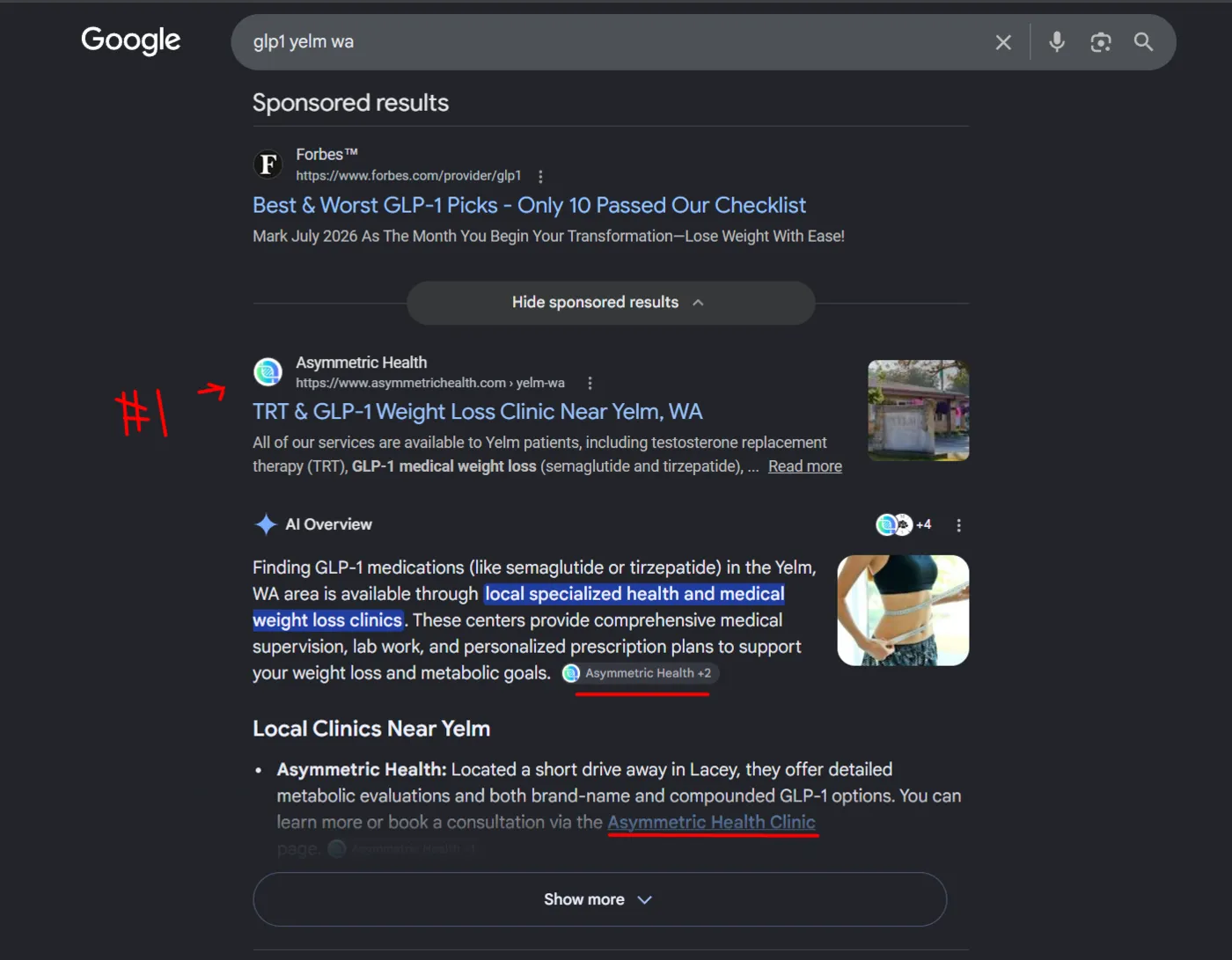
A real "glp1 yelm wa" search: a Forbes affiliate ad loads before any clinic. Our client holds the #1 organic spot and the AI Overview mention below it. Click to zoom.
That screenshot is a small-town Washington search, and it still opens with a Forbes affiliate ad. In bigger metros, Google stacks sponsored compounded-semaglutide products from national telehealth brands down the whole right rail. Your competition is telehealth companies with venture funding, affiliate sites with editorial budgets, and compounding pharmacies bidding on your city's name.
Here's what they can't buy: the #1 organic spot, the local map pack, and the AI Overview recommendation for your city. Those go to whoever has the strongest local signals. A single-location clinic can own all three, and the rest of this guide is about how.
The Paid Ads Problem
The first instinct of most clinic owners is to buy Google Ads. For GLP-1 clinics, that instinct runs straight into Google's healthcare and medicines policy. Prescription drug terms are restricted, weight loss advertising has its own certification requirements, and the enforcement lines move without warning. Clinics routinely spend months getting campaigns disapproved, appealing, and getting disapproved again, or they water the ads down until they say nothing a patient would click.
Meta is no friendlier. Its policies around weight loss and prescription products are stricter than Google's in several ways, and account bans in this niche are common enough that agencies specializing in it keep backup ad accounts as standard practice.
We're not anti-ads. Paid search has a place in GLP-1 clinic digital marketing for some offers and some markets, run carefully inside the policy lines. But it is the supplement, not the strategy. The organic listings and the AI Overview have no approval gate, no per-click cost, and no policy reviewer deciding whether your clinic gets seen. Rankings you own beat placements you rent, and in this niche you often can't rent the placement at all.
Local SEO: The Fight Telehealth Can't Win
Hims can outspend you on ads forever. What it can't do is have a Google Business Profile in your city, collect reviews from your neighbors, or write a credible page about serving your community. Those are the exact signals Google uses to rank "near me" searches, and BrightLocal's consumer survey found 87% of consumers used Google to evaluate local businesses. For a GLP-1 clinic, local SEO is the entire home-field advantage.
The foundation looks like this:
- A Google Business Profile built for weight loss searches. Primary category, service list naming each program you offer, photos of the actual clinic and team, and posts that stay current. Most clinic profiles are half-filled and stale, which is why a managed one ranks.
- Reviews with velocity. Steady new reviews every month beat a big pile of old ones. Google reads recency as proof the clinic is active and patients are happy. (More on the compliance side of review responses below, because healthcare has a rule the other industries don't.)
- A city page for every market you serve. Real pages with real local content, one per city, targeting "GLP-1 [city]" and "medical weight loss [city]." This is where most weight loss clinic SEO stops short. The clinic that builds proper city pages takes the secondary markets uncontested.
- Consistent citations. Name, address, and phone matching across the healthcare directories Google trusts: Healthgrades, Vitals, WebMD, Yelp, and the general local stack.
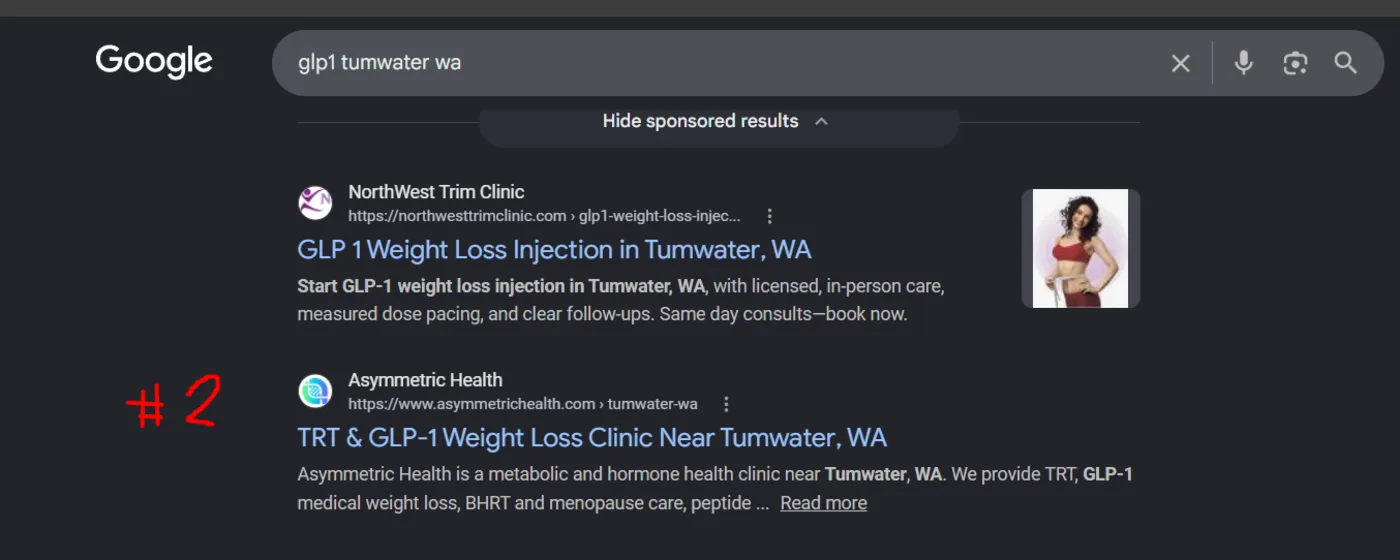
The city-page play in action: our client's Tumwater page ranking for "GLP-1 Tumwater WA", a market one town over from the clinic. Click to zoom.
None of this is exotic. It's the same local SEO discipline that works for any service business, aimed at a niche where almost no competitor is doing it properly because they're all busy fighting the ad platforms.
The Website Patients Convert On
A GLP-1 patient wants three answers before they book: what does it cost, what medication will I actually get, and who's the doctor. Telehealth landing pages dodge all three behind a "start your visit" button. A local clinic that answers them plainly wins the comparison every time.
Structurally, that means a dedicated page for every program: semaglutide, tirzepatide, brand-name versus compounded, and whatever else you offer. One "weight loss services" page trying to cover everything will rank for nothing. Each program page carries its own keyword, its own pricing, and its own schema markup, and they all feed the same booking flow. The brand-versus-compounded page earns its keep: Gallup found 68% of current users are on brand-name medication versus 19% on compounded, so patients absolutely notice which one your pricing describes.
Publish your pricing. This is the one clinic owners resist most, and it's the one that pays off twice. Patients comparing you against telehealth pricing need the number to choose you, and Google's AI needs the number to quote you. Our client's evaluation price appears verbatim in the AI Overview because it's printed on the page where a crawler can read it. Vague pages get skipped; the AI quotes whoever is specific.
Speed and build quality matter here the way they do everywhere in web design: a slow page bleeds bookings. But for GLP-1 clinics, clarity beats cleverness. Answer the three questions above the fold and the rest of the funnel takes care of itself.
Getting Named in the AI Overview
On GLP-1 searches, the AI Overview is the first thing patients read, and it names specific clinics with specific prices. Health is one of the top categories where Google shows AI Overviews, per Semrush's AI Overviews study. The same study found the #1 organic result appears in less than half of desktop AI Overviews, which means ranking well is not enough on its own. Getting quoted is separate work.
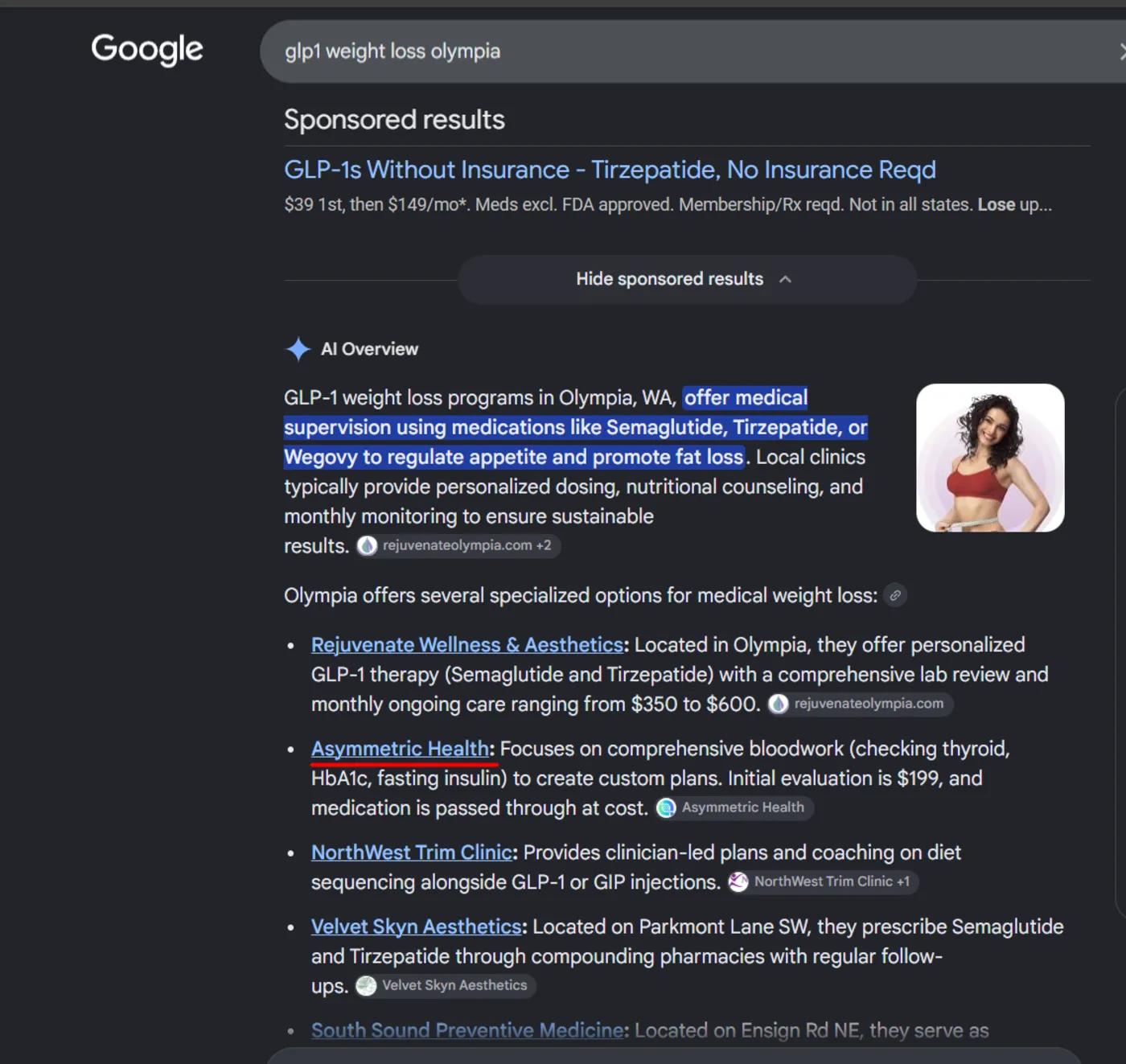
"glp1 weight loss olympia": Google's AI Overview quotes our client's evaluation price and medication model, pulled from pages we structured for exactly that. Click to zoom.
What that work looks like for a weight loss clinic:
- MedicalBusiness and Physician schema on every page, so Google's systems know exactly what the clinic is, who runs it, and what it offers.
- Pricing and program facts published in plain statements an AI can lift verbatim without getting anything wrong. If your pages are vague, the AI quotes someone else.
- Consistent facts across the web. The AI cross-references your site against directories and your Business Profile. Contradictions cost you the citation.
- Content that answers the questions patients actually ask, in the order they ask them. Question-shaped headings, direct answers underneath.
We wrote a full breakdown of how to get cited by ChatGPT and AI Overviews, and our AI SEO service is this exact work productized. For GLP-1 clinics it matters more than anywhere else, because the AI Overview sits above results patients would otherwise scroll to.
Marketing GLP-1s Without Getting Flagged
Your website is not only read by patients. FDA reviewers, ad platform reviewers, LegitScript auditors, and plaintiff attorneys read clinic websites, and weight loss is a niche they read closely. The FDA has published specific concerns about compounded GLP-1 drugs, which makes sloppy claims in this niche more dangerous than in any other local category.
The rules we hold every GLP-1 clinic page to:
- No dosing instructions. Ever. That's between the prescriber and the patient.
- No guaranteed outcomes. No promised pounds, no "no side effects" nonsense. Describe the program, not a result.
- Brand-name versus compounded described accurately. What each is, how the clinic sources it, nothing more.
- HIPAA-safe review responses. A review response that confirms someone is a patient is a violation. Thank the reviewer, speak generally, take details offline.
The instinct is to assume compliant copy can't compete. The opposite is true. Specific, factual, careful copy is exactly what Google's AI can quote without risk, and every page on our client's site went through this filter before it ranked.
What 60 Days Actually Looked Like
Asymmetric Health is a physician-led GLP-1, TRT, and hormone clinic in Lacey, WA. Their Clinical Director watched a local prospect sign up with a Denver telehealth company while his clinic sat down the street. That search leak is what we were hired to plug.
We rebuilt the site from WordPress into a hand-coded custom build, gave every medication and program its own page, built city pages for the surrounding markets, and put the local SEO program from this guide underneath it. Two months later, Google's AI Overview recommends the clinic by name with its actual pricing, and the organic results above the fold belong to them.
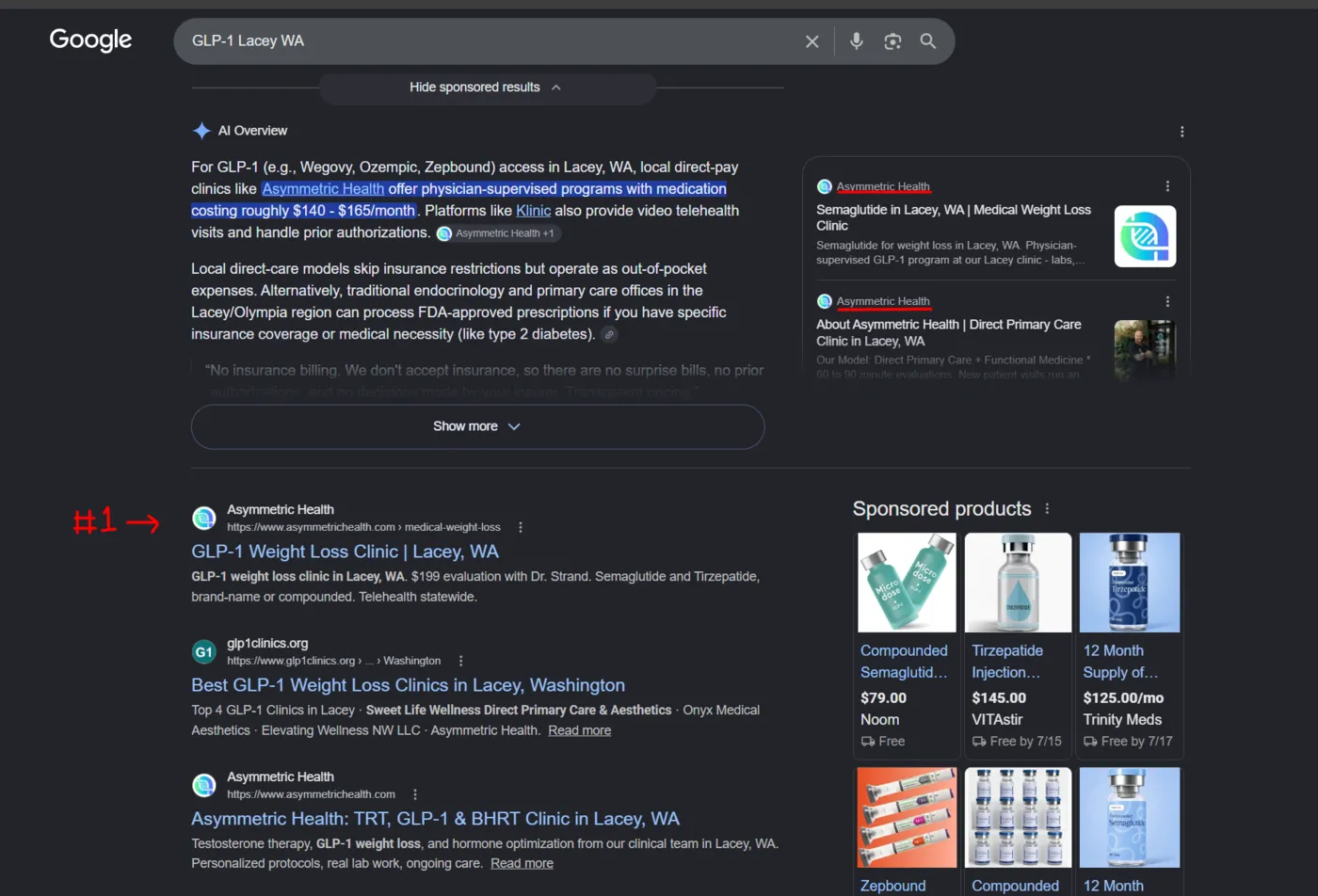
"GLP-1 Lacey WA", live on Google: named in the AI Overview and #1 organic, two months into the program. Click to zoom.
The full write-up with every screenshot is in the Asymmetric Health case study. Sixty days is faster than typical, and we say so plainly: most markets take 2 to 6 months. But the mechanism is the same everywhere, because the weakness is the same everywhere. The national brands can't be local, and almost no local clinic is doing this work properly.
If you run a GLP-1 or medical weight loss clinic and want to know what this looks like in your market, that's what our GLP-1 clinic digital marketing program is. Local SEO, a custom site, and AI SEO, built around compliance from day one. We'll look at your competition and quote it straight.