A CSWE-Accredited MSW Directory Built on Primary Data
We designed and built BestMSWPrograms.org as a reference directory for the Master of Social Work field: 350 CSWE-accredited programs scored on one published methodology. The structure follows how people actually research the decision, from the national MSW ranking down to state-level program pages, plus a plain-language guide to social work licensure and credentials. Every data point traces back to CSWE, the BLS, or a university's own site.
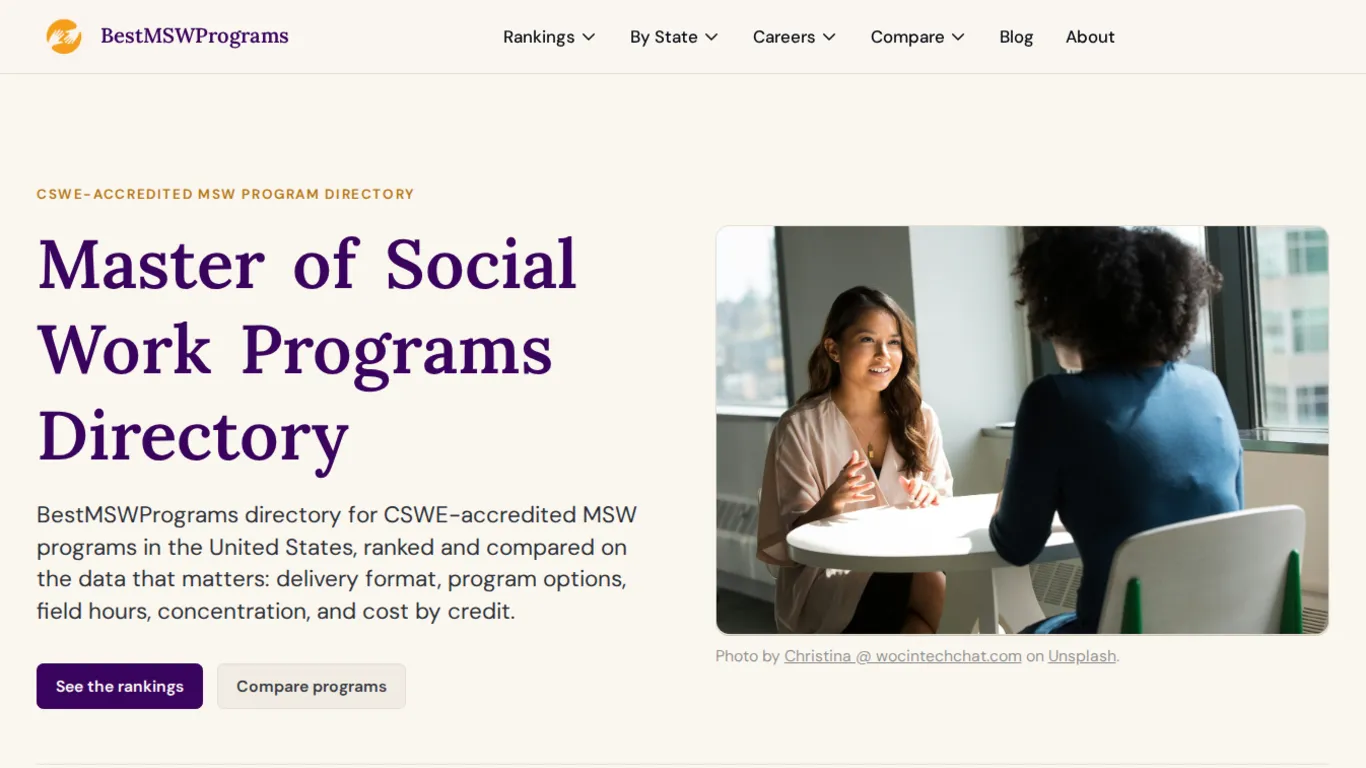
The Challenge
Choosing a Master of Social Work program involves a lot of moving parts, and the search results rarely lay them out cleanly. A prospective student has to weigh accreditation, delivery format, field-hour requirements, concentration, cost per credit, and whether an Advanced Standing track applies to them. Most pages ranking for "best MSW programs" are either a single school marketing its own degree or an affiliate list that recycles the same handful of names without saying how the order was decided.
One detail sits underneath all of it: CSWE accreditation. A degree from a program accredited by the Council on Social Work Education is a prerequisite for licensure in every state, and graduating from an unaccredited program effectively closes off the LMSW and LCSW path. It is the single most consequential thing to get right, and it is the detail generic lists tend to skip.
So the brief was to build the resource that did not exist: a complete, filterable directory of CSWE-accredited MSW programs, scored against one transparent model, with accreditation verified against the official directory, wage and job-growth figures pulled from the Bureau of Labor Statistics, and the licensure picture explained in plain language. A page a community college advisor or a workforce board could comfortably link to.
What We Built
BestMSWPrograms.org is organized around four content areas that map to the order people make the decision in: the rankings and directory, a state-by-state layer, the careers and salary data the degree leads to, and the licensure reference that comes after graduation. 350 CSWE-accredited programs sit underneath, each scored the same way. The sections below describe each piece and what it is built to do.
The rankings and program directory
There are three rankings, each scored on the same model but tuned to a different student. The national MSW ranking covers the top 15 programs in the country. The best online MSW programs ranking scores delivery format more strictly, rewarding fully asynchronous options. And the Advanced Standing MSW ranking focuses on the accelerated, roughly one-year completion paths available to people who already hold a CSWE-accredited BSW.
Below the rankings, a comparison tool lets a visitor filter all 350 programs by format, schedule, Advanced Standing, and concentration, then put up to five side by side. The directory itself breaks down to 51 fully online programs, 184 hybrid, and 115 on-campus, across 32 distinct concentrations, with 331 programs offering an Advanced Standing track.
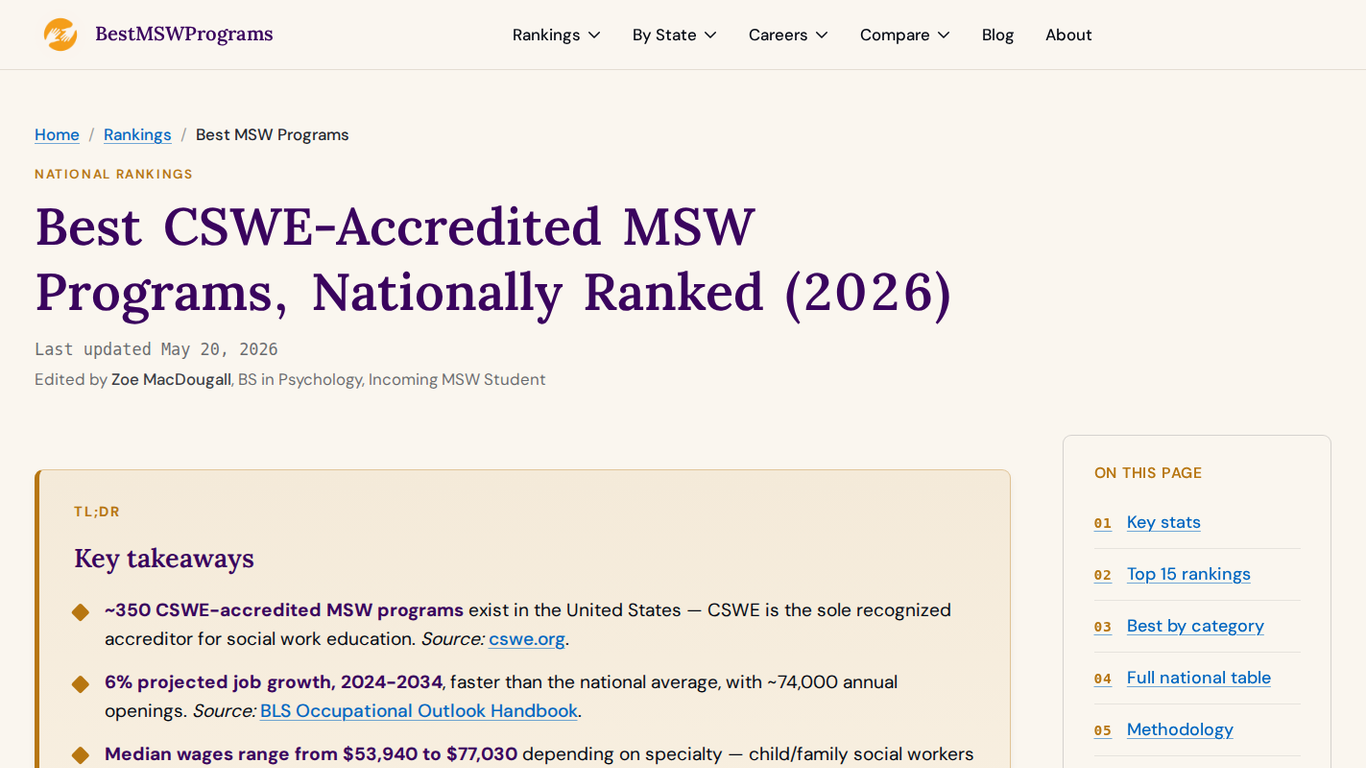
The national MSW ranking opens with a dated last-updated line and a Key Takeaways summary, so a reader sees the conclusion before scrolling into the scored list.
A page for every state
Licensure rules, tuition, and placement options are set at the state level, so the directory has a dedicated page for each one, all 50 states plus the District of Columbia. The California page covers 29 accredited programs, the largest concentration in the country. New York, Texas, Illinois, and Pennsylvania follow with their own program counts and in-state wage context.
The state layer is also the part of the site that fits most naturally into other people's pages. A school describing its own program, or a state workforce board pointing students toward options, has a relevant local page to reference rather than one national list. That is 51 separate, on-topic pages instead of a single URL trying to be everything.
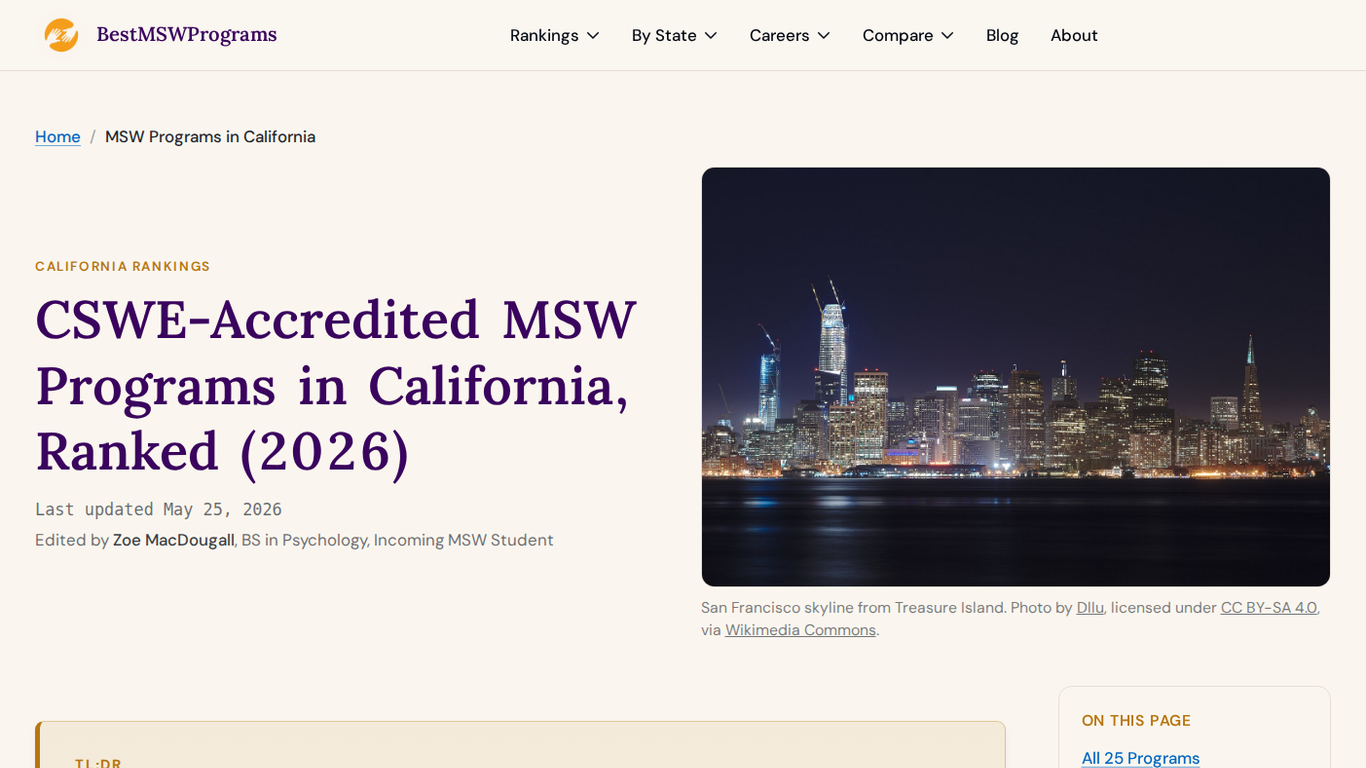
The California MSW page, one of 51 state pages. Each one carries its own program count and state wage data, which is what makes it a useful link target for local schools and boards.
Where the degree leads: careers and salary data
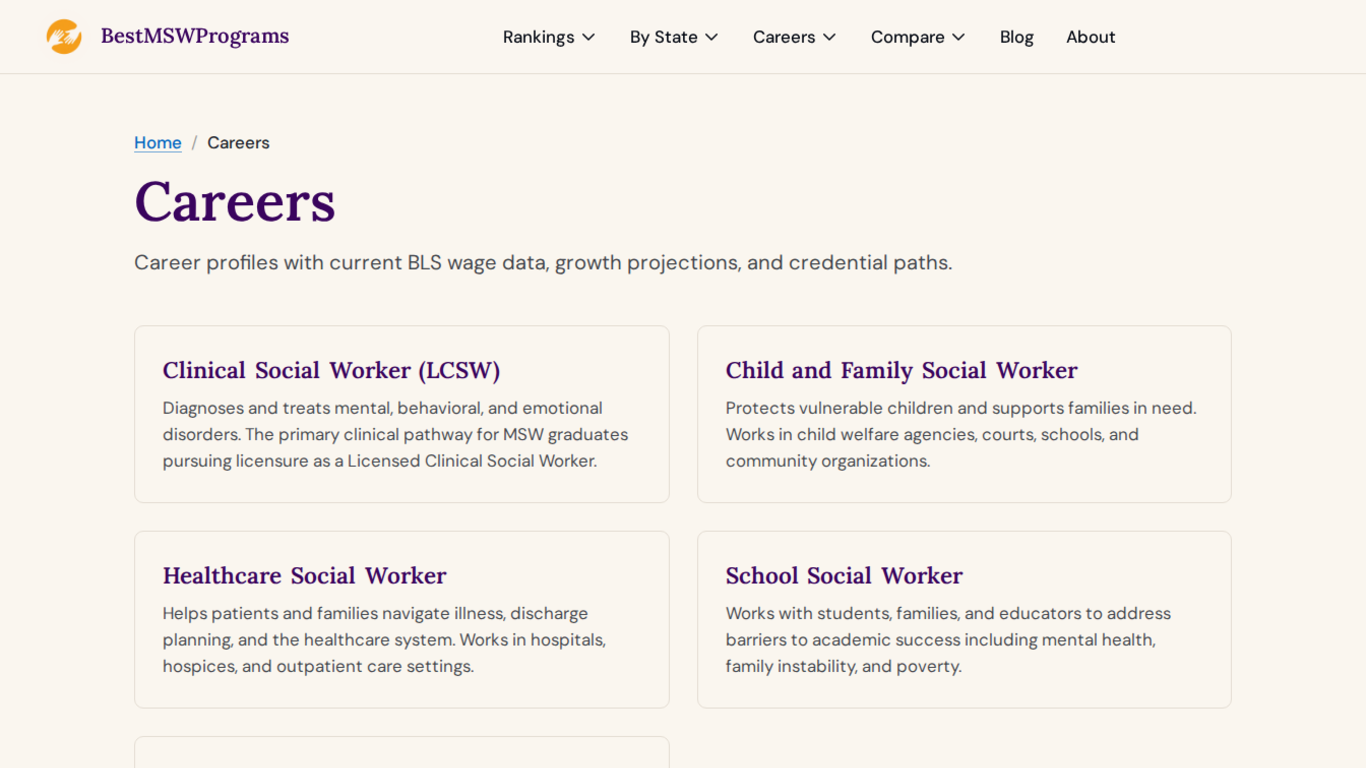
The careers section profiles the five roles an MSW most commonly opens up, each with its own page: clinical social worker (LCSW), healthcare social worker, school social worker, child and family social worker, and social and community service manager.
Each role is paired with a matching salary page drawn from BLS Occupational Employment and Wage Statistics and Employment Projections. The figures are specific: a clinical social worker at a $60,060 median with 10% projected growth, healthcare social workers at $68,090, and social and community service managers at $78,240. Salary pages tend to be the most-cited part of a career site, because writers usually need a sourced number to attach to a job title.
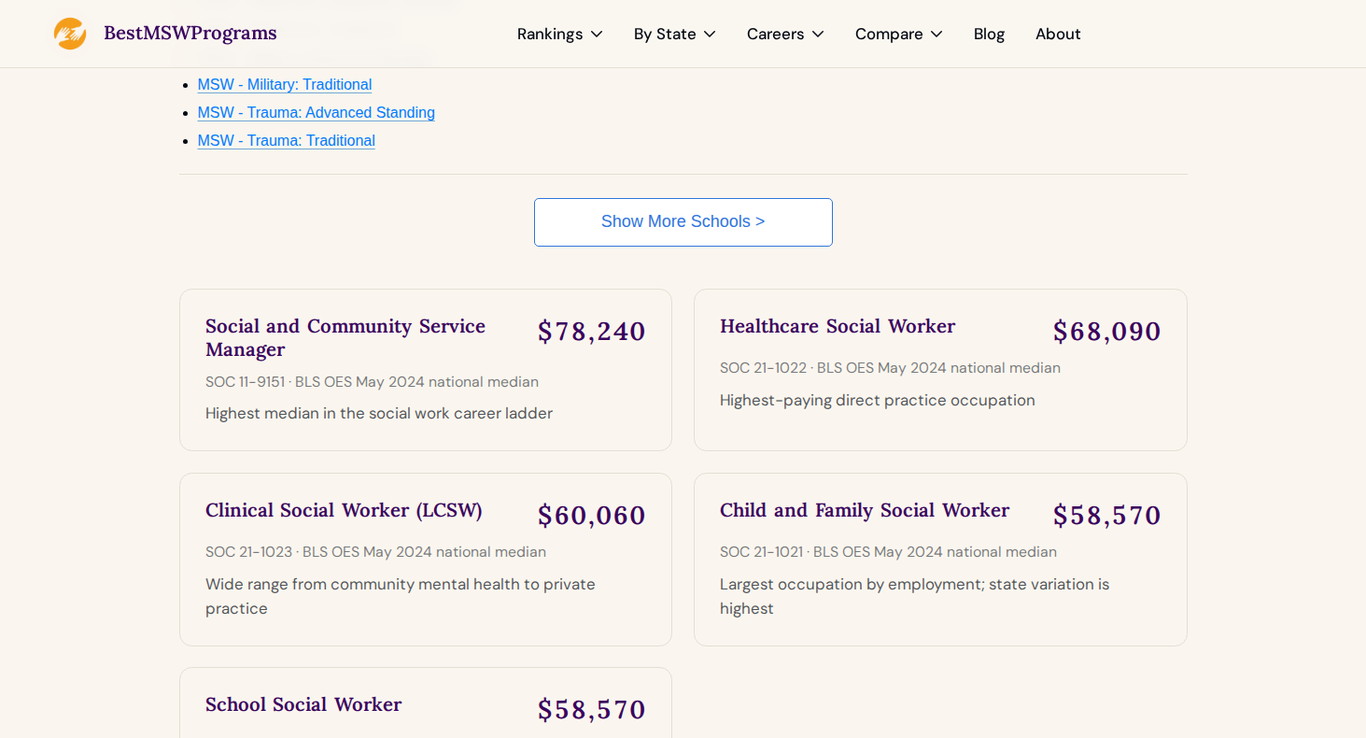
The salary data is presented role by role with the median wage and projected growth, every figure tied to its BLS source so it can be quoted directly.
The licensure and credentials reference
After the degree comes licensure, which is where a lot of prospective students get confused. The credentials reference separates the two things people conflate: licensure, which is legally required and runs through the ASWB exams, and certification, which is voluntary and signals specialty experience. It lays out the path from the master's-level LMSW to the clinical LCSW, the post-degree supervised hours each requires, and the full set of NASW and ABECSW credentials a social worker can pursue later.
Sitting next to it, the CSWE accreditation explainer answers the question the whole site rests on: what accreditation is and why it is non-negotiable for licensure. These explainer pages are the kind a high school counselor or university advising office tends to link, because they settle a recurring question in one clear place.
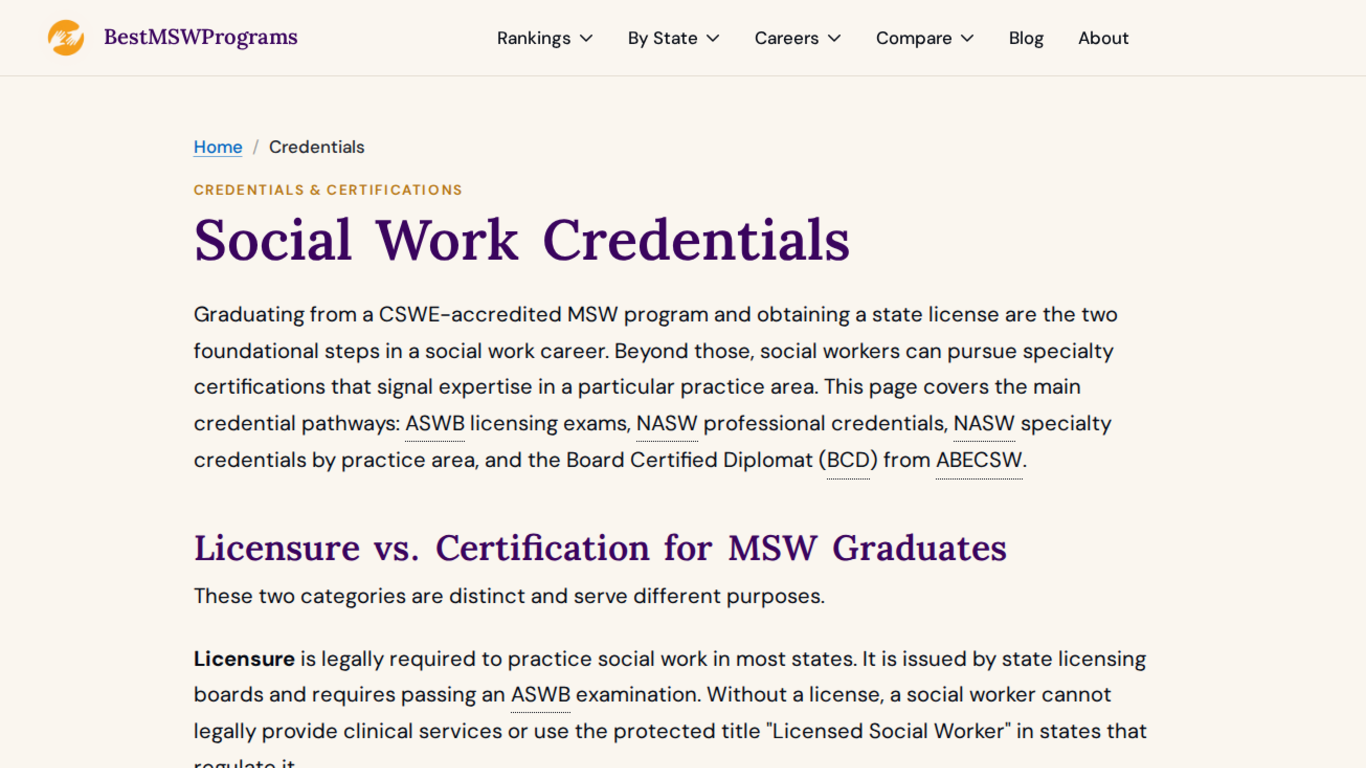
The credentials reference opens by drawing the line between licensure and certification, then details the ASWB, NASW, and ABECSW pathways in full.
A published methodology behind every score
Every ranking on the site is generated by one seven-factor scoring model, and the weights are public: accreditation 25%, program leadership 15%, pathways 15%, delivery format 15%, employer signal and practicum 15%, cost and affordability 10%, and reputation 5%. The same model is applied to every program, with no pay-for-placement and no editorial override.
The data behind those scores comes from primary sources only: official university program pages, CSWE accreditation records, and government labor data. Where a figure could not be verified from a primary source, it was left out of scoring. Publishing the formula is partly a trust signal, since an editor deciding whether to cite a directory wants to see how the order was reached.
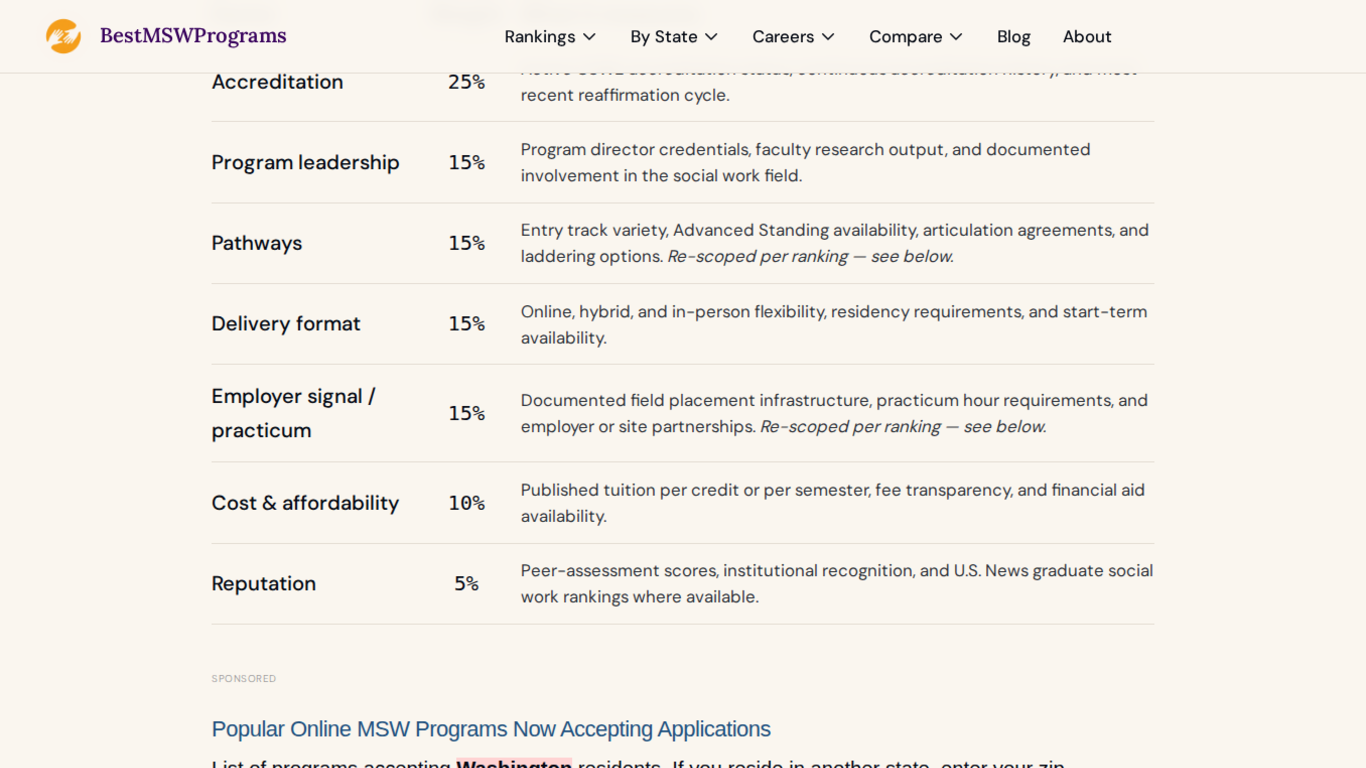
The methodology page lists all seven factors and their weights. Because the model is published and applied uniformly, the rankings are defensible rather than editorial.
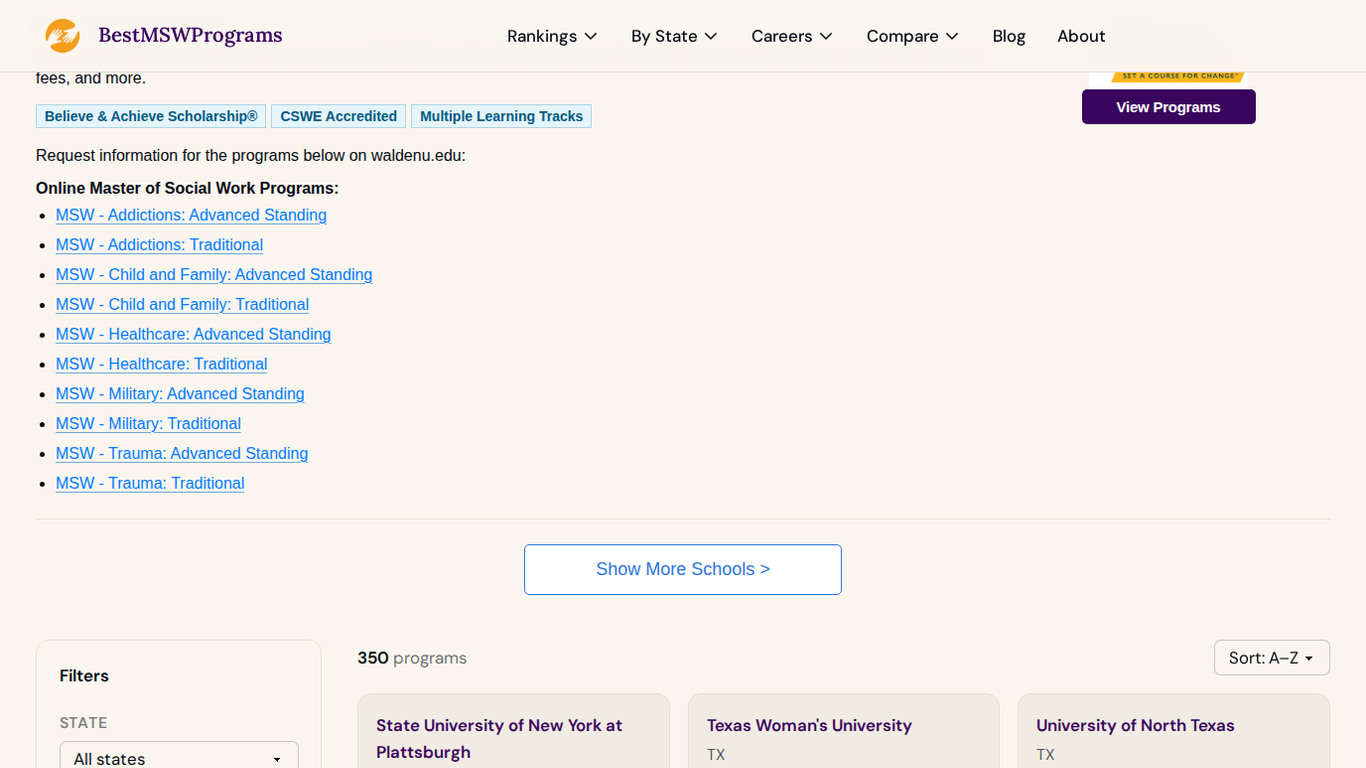
The comparison tool filters all 350 programs and stacks up to five side by side, so a visitor can weigh format, cost, and field hours without leaving the page.
A design that reads like a reference, not a funnel
The design is intentionally restrained: a single accent color, generous type, and data presented in tables and stat cards rather than dressed up as sales copy. Pages carry a last-updated date and link their sources inline. Sponsored listings, where present, are labeled as such and kept visually separate from the scored rankings.
That separation matters for credibility. A directory that clearly distinguishes its editorial rankings from its advertising is one an academic or government editor can reference without worrying they are pointing readers at a lead funnel.
Built static, served from the edge
The site is built on Astro and deployed to Cloudflare, so every page is pre-rendered HTML served from the edge with no client-side framework to download first. That keeps load times fast and Core Web Vitals healthy, which both helps rankings and clears the quick credibility check an editor runs before linking an unfamiliar domain.
Each template emits Schema.org JSON-LD, including Organization, Article, BreadcrumbList, and FAQPage markup, which helps the directory surface inside Google's AI Overviews and tools like Perplexity, an increasingly common starting point for new citations.
How the Structure Supports Link Building
The point of organizing the site this way is that different audiences each find a page worth referencing, and each of those pages reads as a genuine resource rather than a pitch. We did not build pages just to have somewhere to point a link. We built the pages a student would actually use, and they happen to be the same pages a school, board, or writer would cite. A few patterns hold the strategy together.
Geographic pages
The 51 state pages, like Florida, Washington, and New York, give every local school and workforce board a relevant page to reference. Geography is how this information is already organized, so the pages map onto links people would want to make anyway.
Explainer pages
Pages like the CSWE accreditation guide and the licensure and credentials reference answer questions advisors field constantly. An explainer that settles a recurring question in one place is the kind of page counselors and advising offices link to so they do not have to re-explain it.
Salary and career pages
The salary data and career profiles are sourced straight from the BLS and cited inline. Wage figures are among the most-referenced content in any career niche, because writers almost always need a number tied to a job title and prefer one they do not have to re-verify.
A transparent methodology
The published methodology underpins the whole thing. Showing exactly how programs are scored, and that the model is applied uniformly, is what lets the rankings be treated as a citable source rather than one site's opinion.
Technology Stack
What Launched
BestMSWPrograms.org went live with the full structure in place. It is built to compound: every program added, every accreditation update, and every refreshed wage figure widens the surface area of useful, linkable pages.
350 CSWE-accredited MSW programs, every one verified against the official CSWE directory and scored on the same seven-factor model.
51 state pages covering all 50 states plus DC, each an individually relevant reference for the schools and workforce boards in that state.
Three rankings (national, online, and Advanced Standing) plus a comparison tool that filters all 350 programs and stacks five side by side.
A licensure and credentials reference plus a CSWE accreditation explainer, with career and salary data for the five core social work roles sourced from the BLS.
Fast, statically generated pages on Cloudflare with full Schema.org JSON-LD, so the directory is eligible to surface in AI overviews and generative search.
The approach is the same one behind our other education directories: build the resource the niche is missing, source it from primary data, publish the methodology, and let the structure do the work of earning links over time. A directory built this way tends to accumulate references in a way no single ranked list can.
Need an Authority Site That Earns Links on Merit?
We build directories and reference sites sourced from primary data, with the methodology published and the structure designed so the right pages get cited.
Start Your Project