AI Receptionist: Off-the-Shelf App or Custom-Built? How to Choose
Missed calls cost work, and an AI receptionist can answer every one. The real decision is whether a ready-made app fits how your business runs, or whether it's worth building one around your process. Here's how to tell.

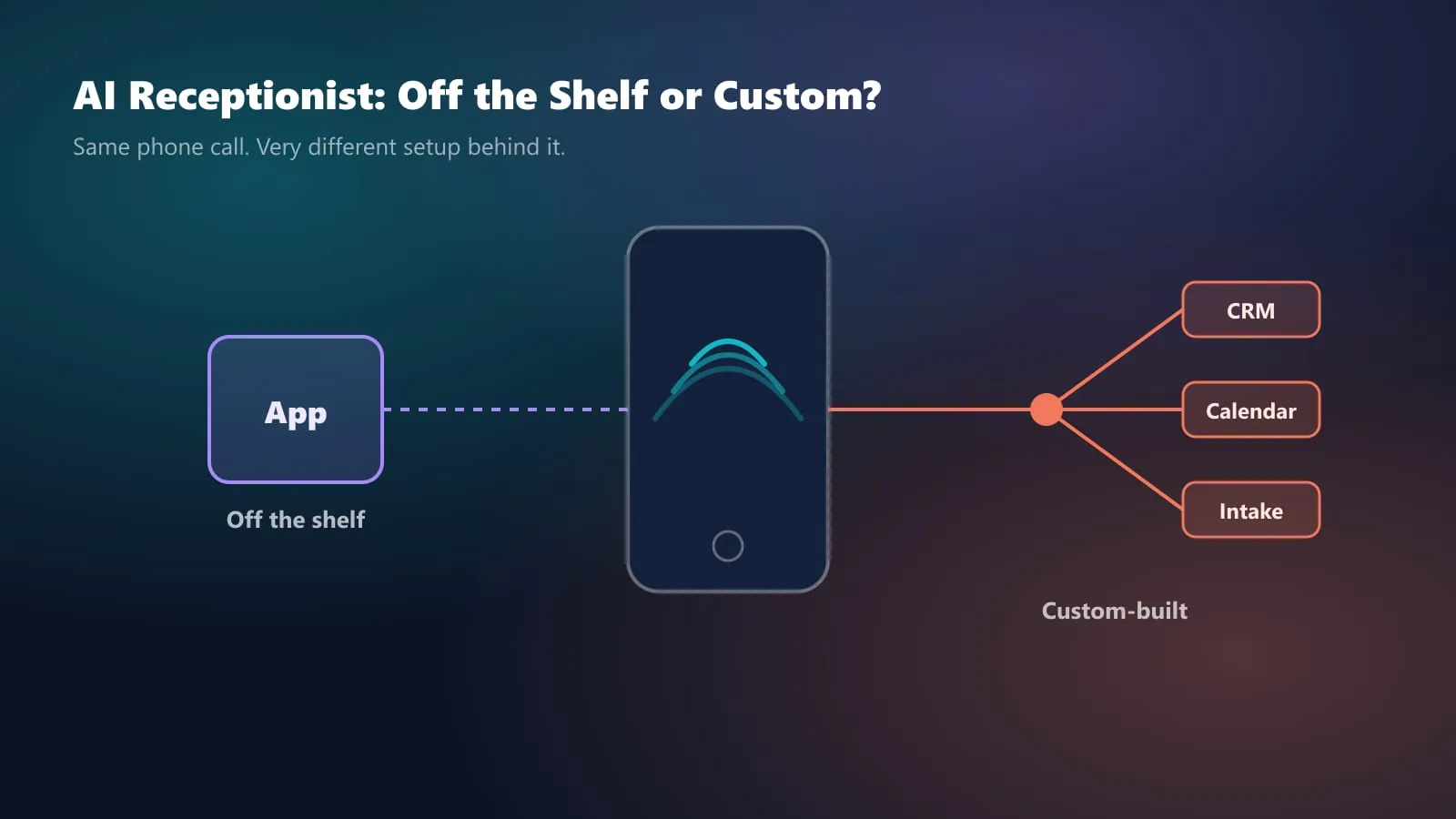
To the caller, every AI receptionist sounds similar. What happens behind the call is the real difference.
The Short Answer
Pick the app for standard needs. Build custom when your process is the product.
An off-the-shelf AI receptionist is the right call when your calls are simple and you want something running this week. A custom-built AI receptionist wins when it has to follow your intake rules, write to your CRM, book against your real schedule and talk to the other software you already pay for. Neither is better in general. The question is how much of your business lives in the details of a phone call.
We build custom software, so you might expect us to tell you everyone needs a custom build. Most don't. Plenty of businesses are well served by an AI phone answering app they can set up in an afternoon. This guide is about telling the two situations apart.
What an AI Receptionist Actually Does
An AI receptionist answers your business line with a natural-sounding voice, understands what the caller wants and handles the routine part of the conversation. Depending on how it's set up, that can include:
- Answering common questions about hours, services, service area and pricing ranges
- Collecting the caller's details and the reason for the call
- Booking, moving or canceling appointments
- Sending urgent calls to a person right away, because good AI phone answering knows when to step aside
- Texting or emailing your team a summary of every call
You'll also see the terms AI voice agent and AI phone answering service. An AI voice agent is the broader idea: software that holds a spoken conversation and takes actions, on inbound or outbound calls. An AI phone answering service is usually the business-facing version of the same thing, sold as a replacement or backup for a human answering service. The AI receptionist sits in the middle: a voice agent whose whole job is your front desk.
When an Off-the-Shelf AI Receptionist Is the Right Call
A packaged app makes sense when the calls you get are predictable. If most callers want your hours, a quote request form, or a slot on a standard calendar, an off-the-shelf AI receptionist will cover it. Its strengths are real:
- Speed. A packaged AI receptionist can usually be answering calls the same day.
- A predictable monthly cost. You pay a subscription instead of a build.
- Someone else maintains it. Updates and voice improvements arrive without you lifting a finger.
- It's easy to try. If it doesn't fit, you cancel.
For an AI receptionist for small business owners with a single location, a simple calendar and no CRM, this is often the smartest place to start. You learn what your callers really ask, which is useful even if you outgrow the app later.
Where Off-the-Shelf Apps Run Out
The trouble starts when a phone call is really the first step of a process that only your business runs. That's where packaged tools tend to bend your workflow to fit their settings, instead of the other way around, and a generic AI receptionist starts costing you leads instead of saving them. Watch for these signs:
- Your intake has rules. A law firm screens case types, a contractor needs the job address and scope, a clinic needs to know whether a patient is new. Generic question flows miss the questions that decide whether a lead is worth calling back.
- Your schedule is complicated. Crews, territories, job lengths and travel time don't fit a basic booking widget.
- Your data has to land somewhere. If every call should create a contact, a job or a case in your own system, you need more than a summary email.
- You rely on other vendors. Dispatch tools, practice management software, payment systems. The AI phone answering setup has to read from and write to them.
- You want to own it. With a subscription, the price, features and terms can change under you. A system built for you is yours.
Off-the-Shelf vs Custom AI Receptionist, Side by Side
| Off-the-shelf app | Custom-built | |
|---|---|---|
| Time to launch | Same day to a few days | Scoped to the project; you get a timeline before work starts |
| Cost shape | Monthly subscription | A build, then upkeep |
| Fits your process | You adapt to its settings | It follows your intake, scheduling and routing rules |
| Connects to your software | Whatever integrations the app offers | Built to read from and write to the systems you use |
| Ownership | You rent it | Built for you, terms in your agreement |
| Best for | Simple, predictable calls | Calls that start a real workflow |
One rule of thumb: if you can describe what should happen on every call in a few sentences, start with an app. If describing it takes a whiteboard, it's probably worth building.
Five Questions to Ask Before You Choose an AI Receptionist
- What do callers actually ask? Pull a week of calls. If most are routine, a packaged AI receptionist will handle them.
- What has to happen after the call? A text to the owner is easy. A new record in your CRM with the right fields is a different job.
- Which systems does it need to touch? List every tool the call should read from or update.
- Who handles the edge cases? Decide which calls must reach a person, and how fast.
- What happens if the vendor changes? Think about pricing changes, discontinued features and moving your data out.
If your answers point toward a custom AI receptionist for small business use, that doesn't mean a giant project. Many of the custom builds worth doing are narrow: one intake flow, one integration, done properly.
How We Build a Custom AI Receptionist
We don't sell a plug-in app. We start by understanding what your business needs from the phone, then Taylor builds it. The process looks like this:
- A working conversation, not a sales deck. We go through your calls, your intake questions and where leads fall through today.
- A plain-English scope. What the AI receptionist will handle, what goes to a person, and which systems it connects to.
- The build. Call handling, booking logic and the integrations into your CRM and other vendors.
- Testing on real scenarios before it answers a single customer.
- Support after launch, because call patterns change and the system should change with them.
Sometimes that conversation ends with us recommending an off-the-shelf app, and that's fine. If you're not sure what you need yet, our AI consulting starts with exactly that question.
Why Taylor Can Build Your AI Receptionist
Most agencies that offer AI phone tools are reselling someone else's product. Taylor Rupe, our co-founder and CTO, builds software, and the best proof is what we run every day:
- Persilio, the CRM Taylor built in-house. It runs our clients' lead tracking and an automated engine that documents their jobs, creates content from them and posts it.
- Percy, the AI helper agent inside Persilio, which helps clients get things done in the system.
- Client integrations Taylor has built to connect businesses with the third-party vendors they already use.
- Pawsilio, a business management app for dog walkers and trainers he built that's now in beta.
An AI voice agent is the same kind of work: understanding a process, then connecting the conversation to the systems behind it. See what else we build on our AI development page.
Not Sure Which AI Receptionist You Need?
Tell us how your phone works today: who answers, what callers ask, and what has to happen after. We'll tell you honestly whether an app will do the job or whether a custom AI receptionist is worth building. We work with businesses across the United States.
AI Receptionists, Answered
What is an AI receptionist?
An AI receptionist is software that answers your business phone with a natural-sounding voice, understands what the caller needs and handles the routine parts of the call, such as answering common questions, taking details, booking appointments and passing urgent calls to a person.
Is an AI receptionist worth it for a small business?
It often is when calls go unanswered during jobs, after hours or at lunch. For simple, predictable calls, an off-the-shelf app is usually the cheapest way to start. A custom build makes sense when calls need to follow your own intake rules or update the software you already use.
What's the difference between an AI phone answering service and a human answering service?
A human answering service uses live operators working from a script. An AI phone answering service uses software to hold the conversation, which means it can answer at any hour and connect directly to your calendar or CRM. Many businesses use AI for routine calls and keep a person for sensitive ones.
Can an AI receptionist connect to my CRM?
Some apps offer integrations with popular tools. If yours isn't supported, or you need the call to create records with your own fields and rules, that's where a custom build comes in. Taylor has built integrations between client businesses and their third-party vendors.
How much does AI phone answering cost?
Off-the-shelf AI phone answering is usually a monthly subscription, often priced by minutes or calls. A custom build is a one-time project plus upkeep, priced after we scope what it has to do. We'd rather show you both options than quote a number before we understand your calls.
Can an AI receptionist replace my front desk staff?
It can take the routine calls off their plate, especially after hours and at busy times. Most businesses keep people for sensitive conversations, complaints and anything that needs judgment, and use the AI receptionist to make sure no call goes unanswered.
Do you sell an AI receptionist app?
No. We don't resell a plug-in product. We learn how your calls and intake work, then build what fits, or tell you when an off-the-shelf app is the better choice.
How long does a custom AI receptionist take to build?
It depends on what it has to do and how many systems it connects to. A single intake flow is a much smaller job than a full scheduling and dispatch integration. We give you a scope and a timeline before any work starts.
Are there rules for AI voice agents that make outbound calls?
Yes. The FCC has ruled that AI-generated voices count as artificial voices under the Telephone Consumer Protection Act, so outbound robocalls using them need the same consent as other prerecorded calls. Inbound reception is a different situation, but it's worth checking the rules for your industry and state.