SEO vs AEO vs GEO: What's the Difference and Which Do You Need?
Search now has three jobs. Rank in the results, become the answer, and get named when AI writes the answer itself. Here's what SEO, AEO and GEO each mean, how they compare, and the order to tackle them in.

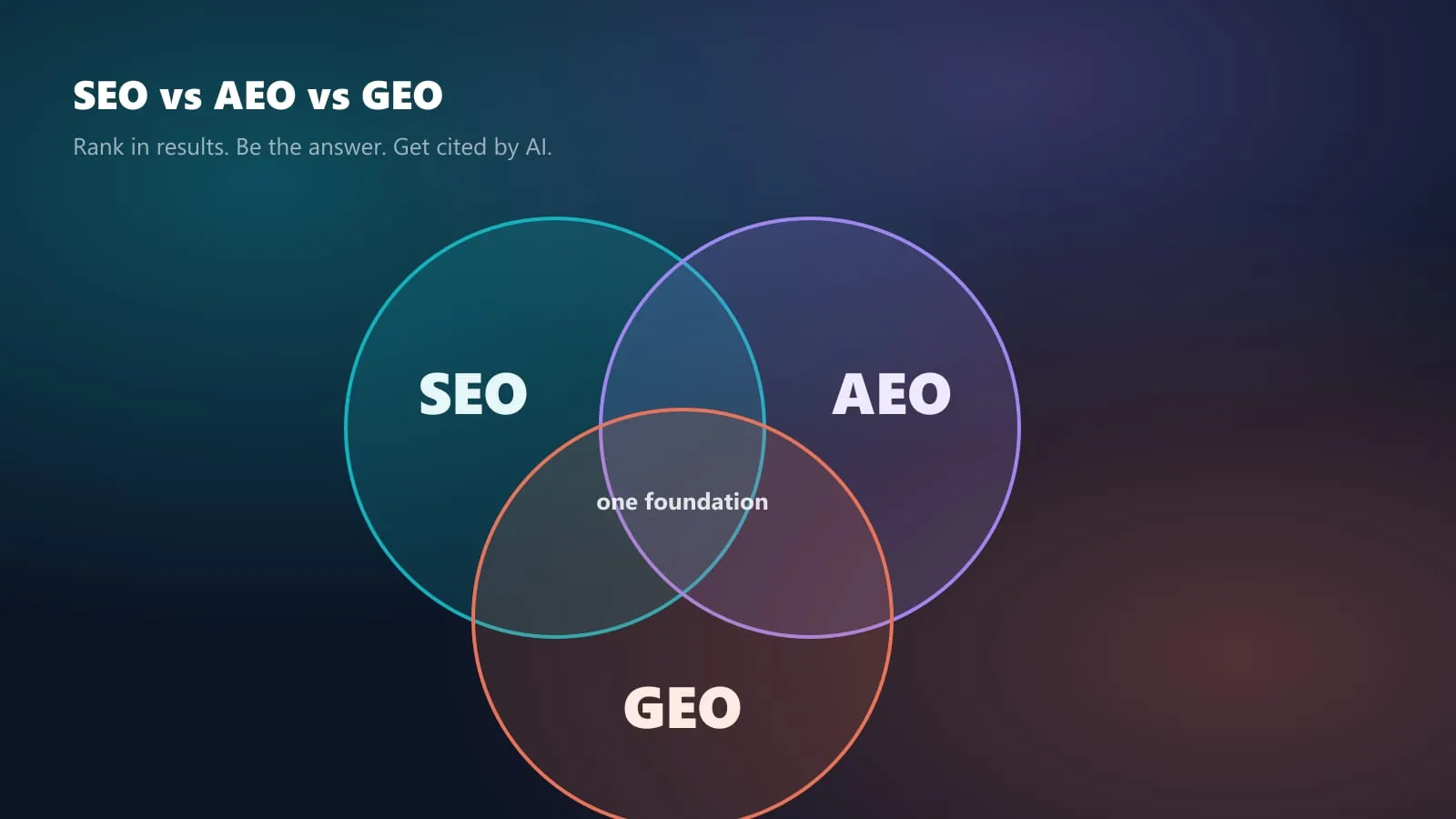
Three names, one foundation: rank in results, be the answer, get cited by AI.
SEO vs AEO vs GEO: The Short Answer
Three jobs, one foundation
SEO gets your page ranked in search results. AEO gets your content pulled out as the direct answer. GEO gets your business cited and recommended inside AI-generated answers from ChatGPT, Gemini, Perplexity and Google's AI features. They share the same foundation, so you don't pick one. You build the foundation once and shape it for all three.
The acronyms make this sound more complicated than it is. Every one of them is about the same thing: being the source a search tool trusts when someone asks a question your business can answer. What changes is where that answer shows up and how it gets delivered.
If you only remember one thing, remember the order. Rankings come first, because the AI tools lean heavily on pages search engines already trust. Answer-ready content comes next. Being named by generative AI is what you earn when the first two are in place.
SEO vs AEO vs GEO, Side by Side
Here is how the three compare on the things a business owner actually cares about.
| SEO | AEO | GEO | |
|---|---|---|---|
| Full name | Search engine optimization | Answer engine optimization | Generative engine optimization |
| The goal | Rank your pages in search results | Become the direct answer to a question | Get cited or recommended in AI-written answers |
| Where it shows up | Google's organic results and the map pack | Featured snippets, People Also Ask, voice assistants, answer boxes | ChatGPT, Gemini, Perplexity, Google AI Overviews and AI Mode |
| What wins | Relevance, authority, technical health, reviews | Clear, short answers to real questions, good structure | Being the clearest, most trusted and most quotable source on the topic |
| How you measure it | Rankings, clicks and leads from search | Snippet and answer-box appearances | Checking real AI answers and tracking leads from AI assistants |
| Time to results | Months, and it compounds | Often faster once pages rank | Follows authority; months, not weeks |
Notice how much the bottom rows overlap. That's the point: the work stacks. A page that ranks, answers the question in its first two sentences and carries clean schema is doing SEO, AEO and GEO at the same time.
GEO vs SEO: Ranking a Page or Being the Recommendation
The difference in a GEO vs SEO comparison comes down to what the searcher sees. Classic SEO gets you a spot in a list of links, and the searcher still has to choose. GEO gets you named inside the answer itself, before anyone scrolls to the list.
The term generative engine optimization comes from a research paper by a team at Princeton, Georgia Tech, the Allen Institute for AI and IIT Delhi, presented at KDD 2024. They tested how content changes affect whether generative engines cite a source, and found that adding things like citations, quotations and statistics made pages more likely to be used. In plain terms: specific, well-supported content gets quoted.
What carries over from SEO
- Authority. AI answers lean on sources that search engines already rank and trust.
- Technical health. If a crawler can't read your page cleanly, no model can quote it.
- Reviews and a consistent business profile. Generative engines check whether the web agrees about who you are.
What GEO adds
- Answer-first writing, so the quotable sentence sits right under the heading.
- Named entities and specifics: your services, your service area, your real numbers.
- Consistent facts everywhere your business appears, so the model isn't guessing.
Seen as seo vs geo, one isn't replacing the other. GEO is what strong SEO turns into when the results page starts writing its own answers. We cover the full method in what is generative engine optimization.
AEO vs GEO: Close Cousins, Different Eras
AEO is the older of the two. It grew up around featured snippets, People Also Ask boxes and voice assistants, where a search tool lifts one short answer from one page and reads it back. GEO arrived with tools that write a fresh answer from several sources and cite the ones they used.
In practice, the AEO vs GEO line is blurry, and plenty of people use the terms interchangeably. Google's AI Overviews sit right on the border: it's an answer box, and it's generated. The work that wins both is the same: a direct answer near the top of the page, structure a machine can follow, and enough authority that the tool trusts you over the next result.
| AEO | GEO | |
|---|---|---|
| Output | One extracted answer, often word for word | A new answer written from several sources |
| Typical surfaces | Featured snippets, voice, People Also Ask | ChatGPT, Gemini, Perplexity, AI Overviews |
| Credit you get | Your snippet, often with a link | A citation or a by-name recommendation |
Our deeper explainer, what is answer engine optimization, walks through the formatting that gets content extracted.
SEO vs AEO: The List or the Answer
SEO aims for position. AEO aims for extraction. A page can rank third and still win the answer box if it answers the question more cleanly than the pages above it, which is why SEO vs AEO is less of a contest than it sounds.
The practical difference shows up in how a page is written. An SEO page can take a few paragraphs to build up to its point. An AEO page states the answer first, in a sentence or two, then earns the click with the detail underneath. We write service pages the second way now, because it works for both.
Which One Does Your Business Need?
All three, built in the right order. Skipping straight to AI visibility rarely works, because the AI tools borrow trust from search. Here's the sequence we use:
- Fix the foundation. A fast site search engines can crawl, one page per service, and a complete Google Business Profile.
- Rank for the searches that bring work. Local and organic rankings are still where most leads come from, and they feed everything else.
- Make every page answer-ready. Lead with the answer, add FAQs written the way customers ask, and add schema that labels your business clearly.
- Check the AI answers and track the leads. Ask ChatGPT, Gemini and Google the questions your customers ask, and record which leads came from AI assistants.
If you've read that SEO is finished, it isn't. The tools changed where the answer appears, not what earns it. We made that case in is SEO dead.
How to Tell Whether It's Working
SEO is the easiest to measure: Search Console shows your rankings and clicks. AEO shows up as answer boxes you can see in the results. GEO is the hard one, because Search Console doesn't show ChatGPT or Perplexity referrals.
We handle that in two ways. We run the real questions through the AI tools on a schedule and record who gets named. And Persilio, the CRM we built, tags every call and form with its source, including AI assistants, so you can see actual leads rather than guessing. Our guide to tracking leads from ChatGPT and AI Overviews shows the setup.
Where Savo Group Fits
Our AI SEO services run SEO, AEO and GEO as one program instead of three invoices. We've been doing SEO for 27 years, and you can see clients named in real AI answers in our guide to getting cited by ChatGPT and AI Overviews.
We work with businesses across the United States. If you want to know where you stand in search and in AI answers today, ask us for a free check.
SEO, AEO and GEO, Answered
What is the difference between SEO, AEO and GEO?
SEO gets your pages ranked in search results. AEO gets your content pulled out as the direct answer in featured snippets, voice results and answer boxes. GEO gets your business cited or recommended in AI-generated answers from tools like ChatGPT, Gemini, Perplexity and Google AI Overviews. They share one foundation, so most businesses need all three working together.
GEO vs SEO: Is GEO Replacing SEO?
No. Generative AI tools lean on pages search engines already trust, so strong SEO is usually what makes GEO possible. The honest framing of SEO vs GEO is a foundation and the layer built on top of it, not a replacement.
Should I budget for GEO vs SEO separately?
Usually not. The pages, schema, reviews and authority that lift your rankings are the same things AI tools look for, so one program covers both. What changes is how you measure it: rankings for search, and AI answer checks plus lead tracking for generative engines.
Are AEO and GEO the same thing?
They overlap so much that many people use the terms interchangeably. AEO started with featured snippets and voice assistants, where one answer is lifted from one page. GEO covers tools that write a new answer from several sources and cite them. The work that wins both is nearly identical.
Which should a small business focus on first?
SEO first. Get a fast, crawlable site, one page per service, a complete Google Business Profile and rankings for the searches that bring work. Then make each page answer-ready, which sets you up for AEO and GEO at the same time.
How do I know if ChatGPT recommends my business?
Ask it the questions your customers ask, in a fresh session, and see who it names. Then track leads by source, because Search Console doesn't report ChatGPT referrals. Our CRM, Persilio, tags calls and forms that come from AI assistants so you can see real results.
Do I need a separate agency for AEO or GEO?
You shouldn't. The same pages, schema and reviews drive all three, so splitting them across vendors usually means paying twice for overlapping work. Our AI SEO services run them as one program.