A BCBA Program Directory Built on Exam Outcomes, Not Reputation
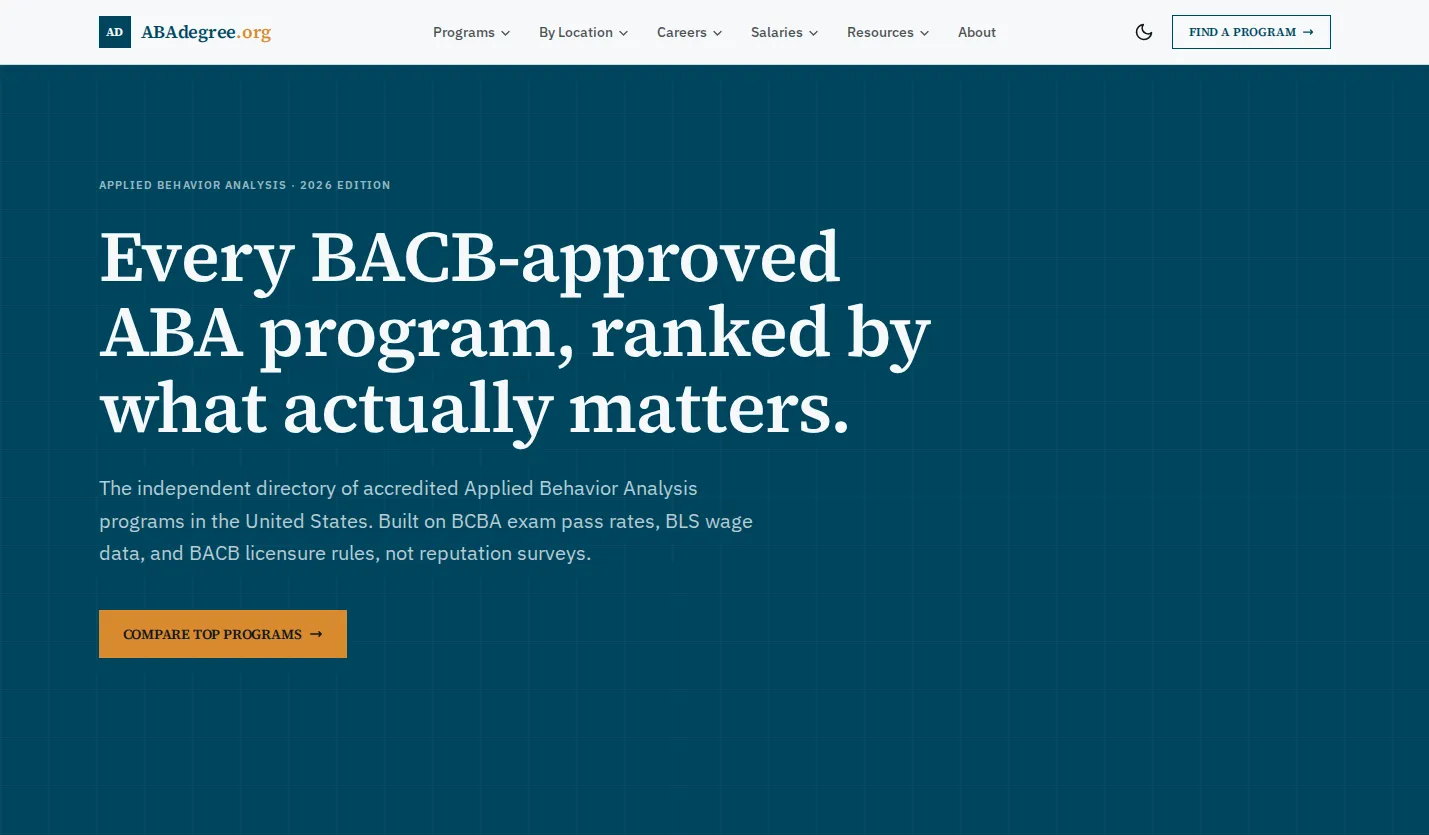
We designed and built ABAdegree.org as an independent directory for the Applied Behavior Analysis field: every BACB-approved program scored on the data that decides a career, led by BCBA exam pass rates. The structure follows how someone actually researches the path, from the national masters ranking down to state-by-state program guides, plus a full careers and salary reference. Every figure traces back to the BACB, ABAI, the BLS, or a university's own disclosures.
The Challenge
Becoming a Board Certified Behavior Analyst is a long, expensive commitment, and the search results rarely lay the decision out honestly. A prospective student has to weigh accreditation tier, BACB exam eligibility, supervised fieldwork support, delivery format, and total cost, all before a single application goes out. Most pages ranking for "best ABA programs" are either a single school marketing its own degree or an affiliate list that recycles the same names without ever saying how the order was decided.
One number sits underneath all of it and almost no list shows it: the BCBA exam pass rate. The national first-time pass rate was about 54% across 192 programs in 2024, which means the average program sends out as many people who fail the exam as people who pass it. The gap between a program at 100% and a program at 40% is the difference between a credential and a sunk cost, and it is the single detail generic rankings skip.
So the brief was to build the resource that did not exist: a complete directory of BACB-approved ABA programs scored against one transparent model led by exam outcomes, with accreditation verified against ABAI, wage and growth figures pulled from the Bureau of Labor Statistics, and the licensure picture explained state by state. A page a school counselor, a workforce board, or a working RBT could comfortably link to.
What We Built
ABAdegree.org is organized around the order people make the decision in: the rankings and program directory, a state-by-state layer, the careers and salary data the field leads to, and an interactive tool that puts a real number on it. Every BACB-approved program sits underneath, each scored the same way. The sections below describe each piece and what it is built to do.
The rankings and program directory
There are five rankings, each scored on the same model but tuned to a different student. The best ABA masters programs ranking is the flagship, since the master's is the degree the BCBA requires. From there the best online ABA programs, cheapest online BCBA programs, and accelerated online BCBA programs rankings each weight one variable more heavily, format, cost, or speed. The best ABA doctoral programs ranking covers the ABAI-accredited PhD route for people headed into research or the BCBA-D.
Each ranking opens with a dated last-updated line and a Key Takeaways box, so a reader gets the conclusion before scrolling into the scored list. To make any list, a program has to hold full ABAI accreditation or a BACB Verified Course Sequence, which is the floor for exam eligibility. Out of more than 200 ABA masters programs in the country, only a handful clear the bar this directory sets.
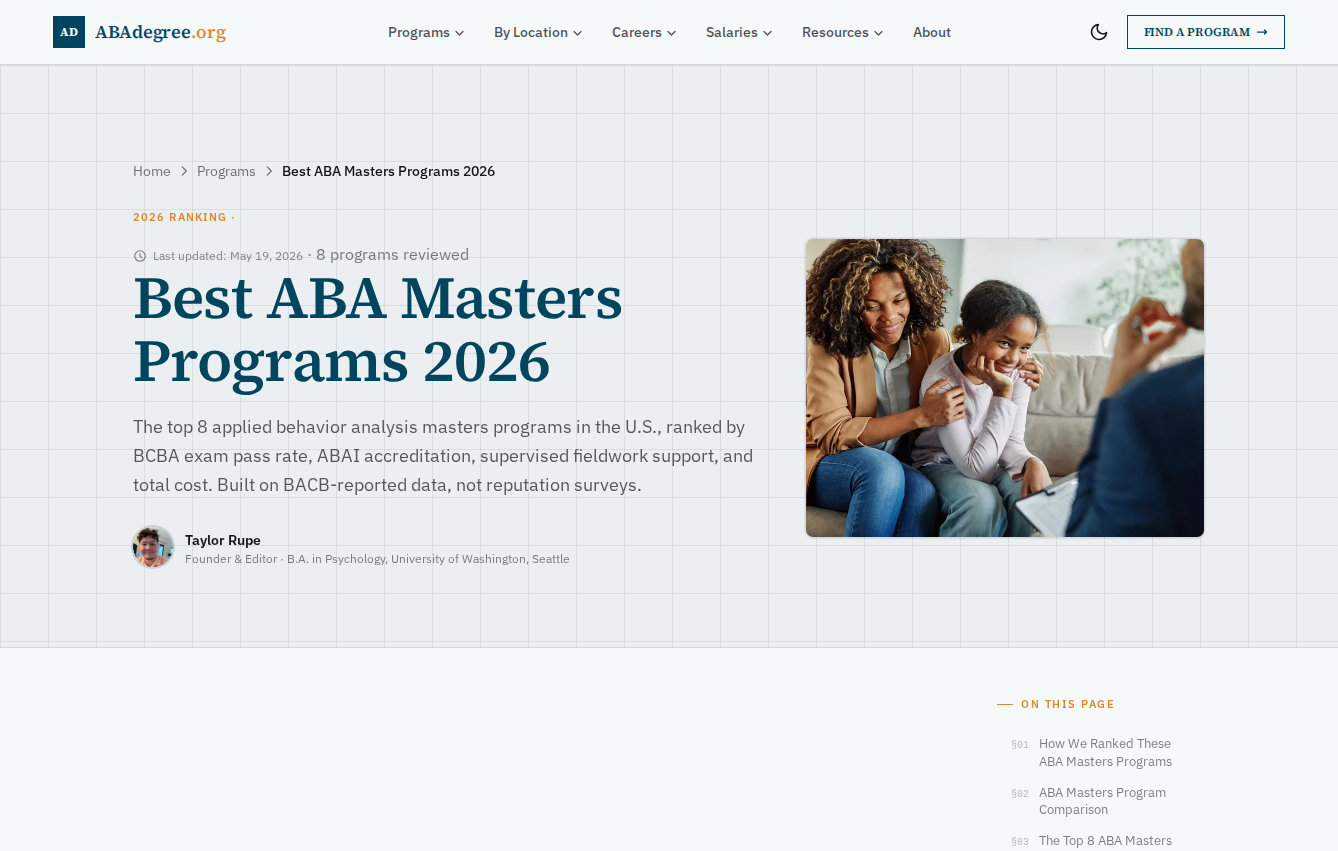
The best ABA masters programs ranking opens with a dated last-updated line and a Key Takeaways summary, then leads into a list scored on exam pass rate, accreditation, fieldwork support, and cost.
A page for every state
Behavior analyst licensure, tuition, and demand are set at the state level, so the directory has a dedicated guide for each one. The by-state hub carries a BACB-approved program count and a median wage for all 50 states, from California with the most programs in the country down to single-program states. Around 40 states plus D.C. now license behavior analysts, and several, like California, Massachusetts, and New York, layer their own requirements on top of BACB certification.
The state layer is also the part of the site that fits most naturally into other people's pages. A university describing its own program, or a state workforce board pointing people toward options, has a relevant local page to reference rather than one national list. On top of the states, high-demand metros like New York City, Los Angeles, and Boston get their own pages.
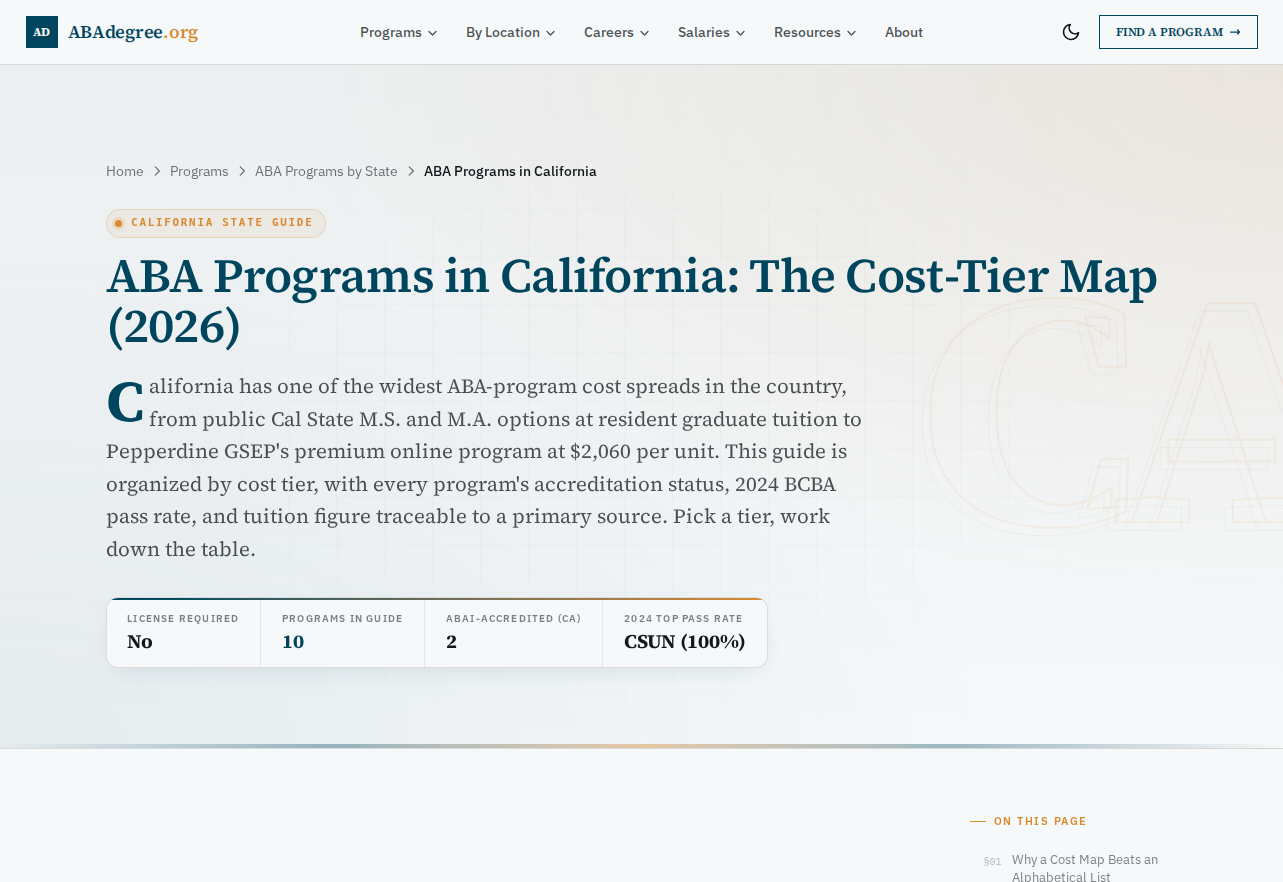
The California guide, one of 50 state pages. Each carries its own program count, licensure notes, and state wage data, which is what makes it a useful link target for local schools and boards.
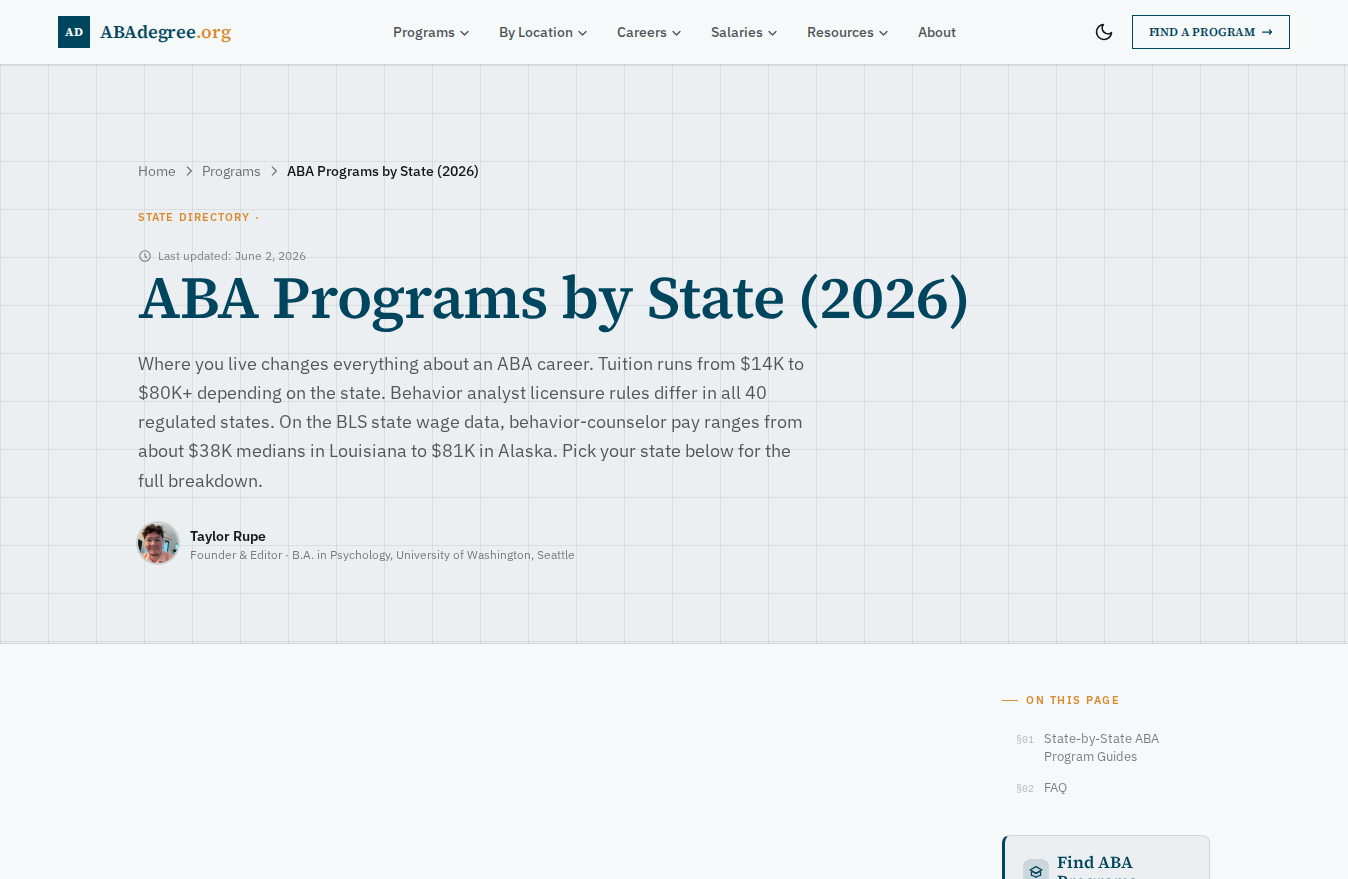
The by-state hub ties every state guide together, with program counts and median pay surfaced at a glance.
The full credential ladder: careers and salary data
The ABA field runs on a credential ladder, not a single job, so the careers section profiles all ten rungs, each on its own page: the 40-hour RBT, the bachelor's-level BCaBA, the master's-level BCBA, and the doctoral BCBA-D, plus adjacent roles like ABA clinical supervisor and clinical director. Each guide gives an honest read on whether the path is worth pursuing, not just a job description.
Every role is paired with a matching salary page drawn from BLS wage data. The figures are specific: a BCBA near an $81,000 median with 19% projected growth, an RBT around $45,000, a BCaBA near $56,000, and a clinical director into six figures at $95,000. Salary pages tend to be the most-cited part of any career site, because writers usually need a sourced number to attach to a job title.
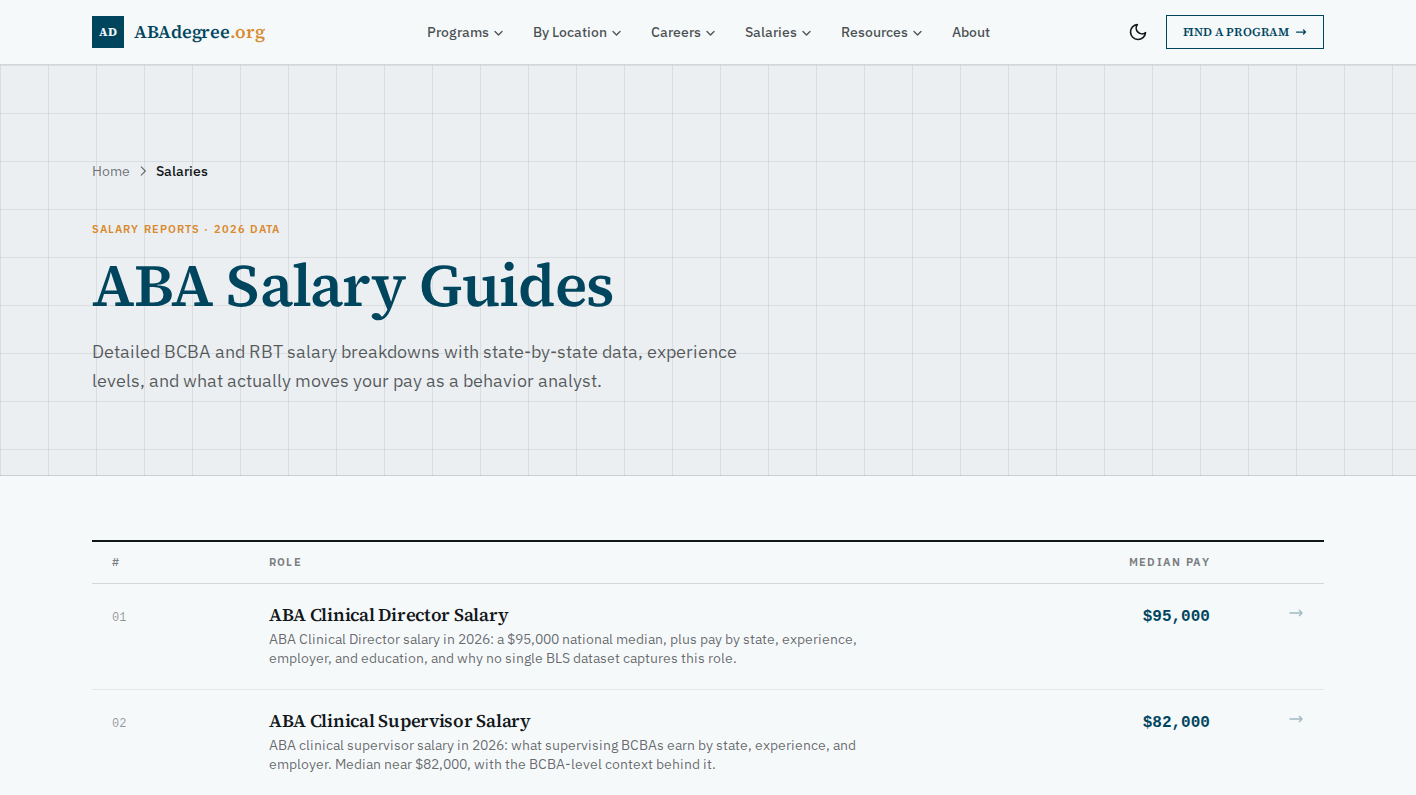
The salary guides are presented role by role with the median wage tied to its BLS source, so each figure can be quoted directly.
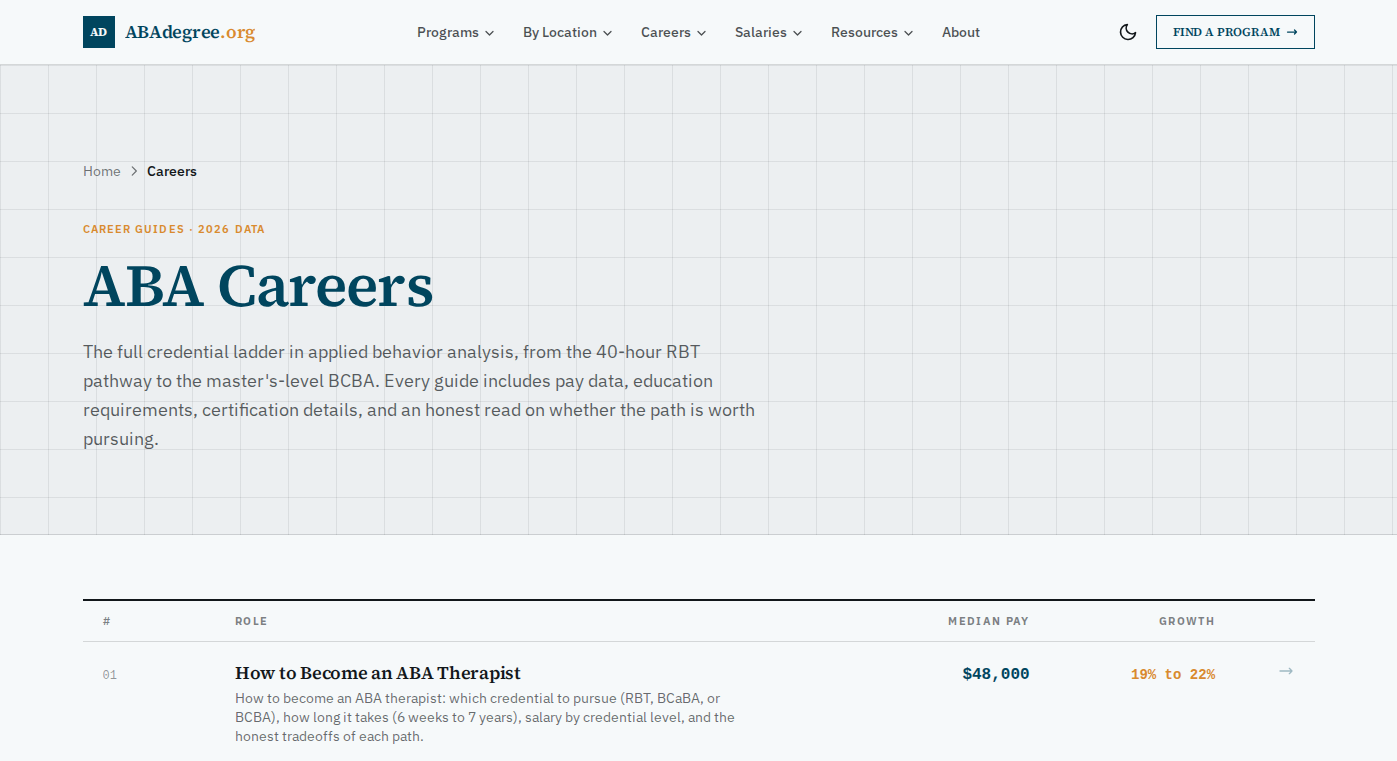
The careers index lays out the full ladder from RBT to BCBA, each row showing median pay and BLS-projected growth before you click in.
An interactive BCBA salary calculator
Career sites usually stop at a national median, which is the least useful number for a real person. So we built an interactive BCBA salary calculator: pick a state, an experience level, and a work setting, and it returns an estimate built on real BLS state wage data for the occupation that includes behavior analysts, not invented figures. The methodology behind the adjustment is published right on the page.
A working tool is also a strong link magnet. An interactive calculator gives a writer or a school something concrete to point readers at, the kind of utility that earns a citation in a way a static table rarely does.
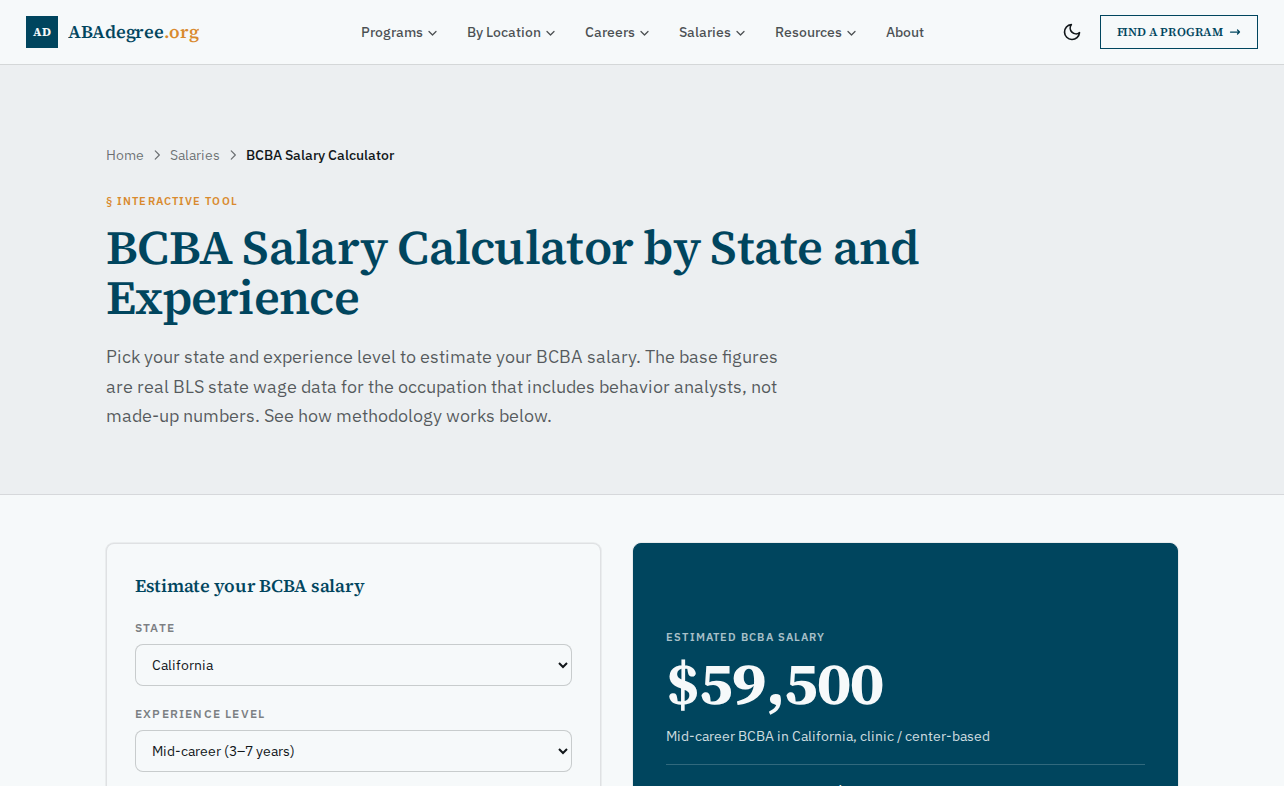
The BCBA salary calculator takes state, experience, and setting and returns a BLS-grounded estimate, with the adjustment methodology shown on the page.
A scoring model that weights outcomes
Most ABA program rankings rely on reputation surveys, U.S. News scores, or sticker price. This one weights outcomes. Every program is scored on the same factors, led by BCBA exam pass rate, then ABAI accreditation status, supervised fieldwork support, and total cost, and the data behind each score comes from primary sources only: BACB-reported exam data, ABAI accreditation records, NCES College Navigator tuition figures, and program disclosures.
The model also stays current with the field. The site flags the BACB's new educational standards taking effect for exam candidates who finish coursework after January 2027, since top ABAI-accredited programs have already updated their curricula while many Verified Course Sequence programs are still catching up. Where a figure could not be verified from a primary source, it was left out of scoring rather than guessed.
A design that reads like a reference, not a funnel
The design is intentionally restrained: a single deep-teal palette with one amber accent, a serif display face for headings, and data presented in tables and stat cards rather than dressed up as sales copy. Pages carry a last-updated date and a named editor byline, and they link their sources inline. Sponsored program listings, where present, are labeled and kept visually separate from the scored rankings.
That separation matters for credibility. A directory that clearly distinguishes its editorial rankings from its advertising is one an academic or government editor can reference without worrying they are pointing readers at a lead funnel.
Built static, served from the edge
The site is built on Astro and deployed to Cloudflare, so every page is pre-rendered HTML served from the edge with no client-side framework to download first. The one interactive piece, the salary calculator, runs as a small script layered on top of static pages. That keeps load times fast and Core Web Vitals healthy, which both helps rankings and clears the quick credibility check an editor runs before linking an unfamiliar domain.
Each template emits Schema.org JSON-LD, including Organization, Article, BreadcrumbList, and FAQPage markup, which helps the directory surface inside Google's AI Overviews and tools like Perplexity, an increasingly common starting point for new citations.
How the Structure Supports Link Building
The point of organizing the site this way is that different audiences each find a page worth referencing, and each of those pages reads as a genuine resource rather than a pitch. We did not build pages just to have somewhere to point a link. We built the pages a prospective behavior analyst would actually use, and they happen to be the same pages a school, board, or writer would cite. A few patterns hold the strategy together.
Geographic pages
The 50 state guides, plus metro pages for places like New York City, Chicago, and Houston, give every local school and workforce board a relevant page to reference. Geography is how this information is already organized, so the pages map onto links people would want to make anyway.
Explainer pages
Resource pages like how to become a BCBA, RBT vs BCBA vs BCaBA, and BCBA license by state answer questions advisors field constantly. An explainer that settles a recurring question in one place is the kind of page counselors and advising offices link to so they do not have to re-explain it.
Salary, career, and tool pages
The salary data, career profiles, and the interactive salary calculator are sourced straight from the BLS and cited inline. Wage figures are among the most-referenced content in any career niche, because writers almost always need a number tied to a job title and prefer one they do not have to re-verify, and a working tool gives them something concrete to send readers to.
A transparent, outcome-led methodology
Showing exactly how programs are scored, led by exam pass rates and applied uniformly, is what lets the rankings be treated as a citable source rather than one site's opinion. Pass-rate data in particular is hard to find compiled in one place, which makes it the kind of figure other pages reach for and link back to.
Technology Stack
What Launched
ABAdegree.org went live with the full structure in place. It is built to compound: every program added, every accreditation update, and every refreshed wage figure widens the surface area of useful, linkable pages.
Five rankings covering 34 reviewed programs, every one scored on the same model led by BCBA exam pass rate, with ABAI accreditation verified against the official directory.
50 state guides plus metro pages for high-demand cities, each an individually relevant reference for the schools and workforce boards in that area.
A full career and salary reference for all ten rungs of the ABA credential ladder, from RBT to BCBA-D, with every wage figure sourced from the BLS.
An interactive BCBA salary calculator that adjusts real BLS state wage data by experience and work setting, with the methodology published on the page.
Fast, statically generated pages on Cloudflare with full Schema.org JSON-LD, so the directory is eligible to surface in AI overviews and generative search.
The approach is the same one behind our other education directories: build the resource the niche is missing, source it from primary data, publish the methodology, and let the structure do the work of earning links over time. A directory built this way tends to accumulate references in a way no single ranked list can.
Need an Authority Site That Earns Links on Merit?
We build directories and reference sites sourced from primary data, with the methodology published and the structure designed so the right pages get cited.
Start Your Project