Amanita Muscaria Product Page
120→303
+153% Google Clicks
Jul 26–Aug 22 → Aug 23–Sep 19, 2026
Ecommerce · Kratom & Botanicals Portland, OR Since 2026
A custom storefront, research-led product guides, and ongoing ecommerce SEO for a family-owned Portland botanicals shop. Google Search clicks more than doubled between June 28–July 25 and August 23–September 19, 2026. Organic search and AI referrals grew alongside them.
Google Search Clicks
1,508 3,166
+110% · Jun 28–Jul 25 → Aug 23–Sep 19, 2026 · Google Search Console
Organic Search Sessions
1,957 4,405
+125% · Jun 28–Jul 25 → Aug 23–Sep 19, 2026 · Google Analytics
Paid Website Checkout Orders
216 322
+49% · Jun 28–Jul 25 → Aug 23–Sep 19, 2026 · All acquisition sources · WooCommerce
Ongoing Ecommerce SEO · September 2026 Results
Herb Stomp’s search traffic has moved well beyond the launch. The custom checkout went live in May 2026. Our ongoing SEO work connects category pages, product descriptions, and researched guides, and the recent results show more people finding all three.
Three consecutive 28-day windows show the build in search traffic. The latest period brought 110% more Google clicks than the first, with another 21% increase over the middle period.
Jun 28–Jul 25
1,508
Google Search clicks · 2026
Jul 26–Aug 22
2,617
Google Search clicks · 2026
Aug 23–Sep 19
3,166
Google Search clicks · 2026
Google Search Console · Retrieved September 21, 2026 · Finalized through September 19, 2026.
Complete seven-day periods · June 28–September 19, 2026
821 Clicks · Latest Week
| Seven-Day Period | Google Clicks |
|---|---|
| Jun 28–Jul 4, 2026 | 372 |
| Jul 5–Jul 11, 2026 | 415 |
| Jul 12–Jul 18, 2026 | 335 |
| Jul 19–Jul 25, 2026 | 386 |
| Jul 26–Aug 1, 2026 | 546 |
| Aug 2–Aug 8, 2026 | 683 |
| Aug 9–Aug 15, 2026 | 721 |
| Aug 16–Aug 22, 2026 | 667 |
| Aug 23–Aug 29, 2026 | 724 |
| Aug 30–Sep 5, 2026 | 787 |
| Sep 6–Sep 12, 2026 | 834 |
| Sep 13–Sep 19, 2026 | 821 |
The gains reach beyond the homepage. The Wild Dagga guide brought in 291 Google clicks, up from 111 in the preceding 28 days. Product and category pages grew too.
120→303
+153% Google Clicks
Jul 26–Aug 22 → Aug 23–Sep 19, 2026
111→291
+162% Google Clicks
Jul 26–Aug 22 → Aug 23–Sep 19, 2026
316→426
+35% Google Clicks
Jul 26–Aug 22 → Aug 23–Sep 19, 2026
Source: Google Search Console page report, retrieved September 21, 2026. Each comparison covers 28 days.
For the same August 23–September 19 window, Google clicks rose from 1,486 in 2025 to 3,166 in 2026: a 113% increase. That longer view sits alongside the recent 28-day comparisons above.
Google Analytics shows the same direction in visits to the store. Organic search sessions grew 125% across the first and latest 28-day windows. Sessions in its AI Assistant channel rose from 90 to 232.
| Measure | Jun 28–Jul 25 | Aug 23–Sep 19 | Change | Source |
|---|---|---|---|---|
| Organic Search Sessions | 1,957 | 4,405 | +125% | Google Analytics |
| AI Assistant Sessions | 90 | 232 | +158% | Google Analytics |
Organic search sessions also rose 26% over the immediately preceding July 26–August 22 period, from 3,486 to 4,405. Sessions and Search Console clicks are different measures and are reported separately.
Google Analytics · Both comparison periods are in 2026 · Retrieved September 21, 2026.
WooCommerce Order Records
The checkout records show growth alongside the traffic. Paid website checkout orders rose from 216 to 322 across the same two 28-day windows. These orders include every acquisition source, so the figures describe the store’s overall website performance.
Jun 28–Jul 25, 2026 → Aug 23–Sep 19, 2026
216→322
+49% Orders
+21%
Increase · Excludes Shipping and Tax
Source: WooCommerce order records, retrieved September 21, 2026. Website checkout only; excludes pending, on-hold, failed, cancelled, fully refunded, staff/phone, and subscription orders. Partial refunds are not reflected in the sales growth comparison. These are all-source sales figures, not profit or revenue attributed solely to SEO.
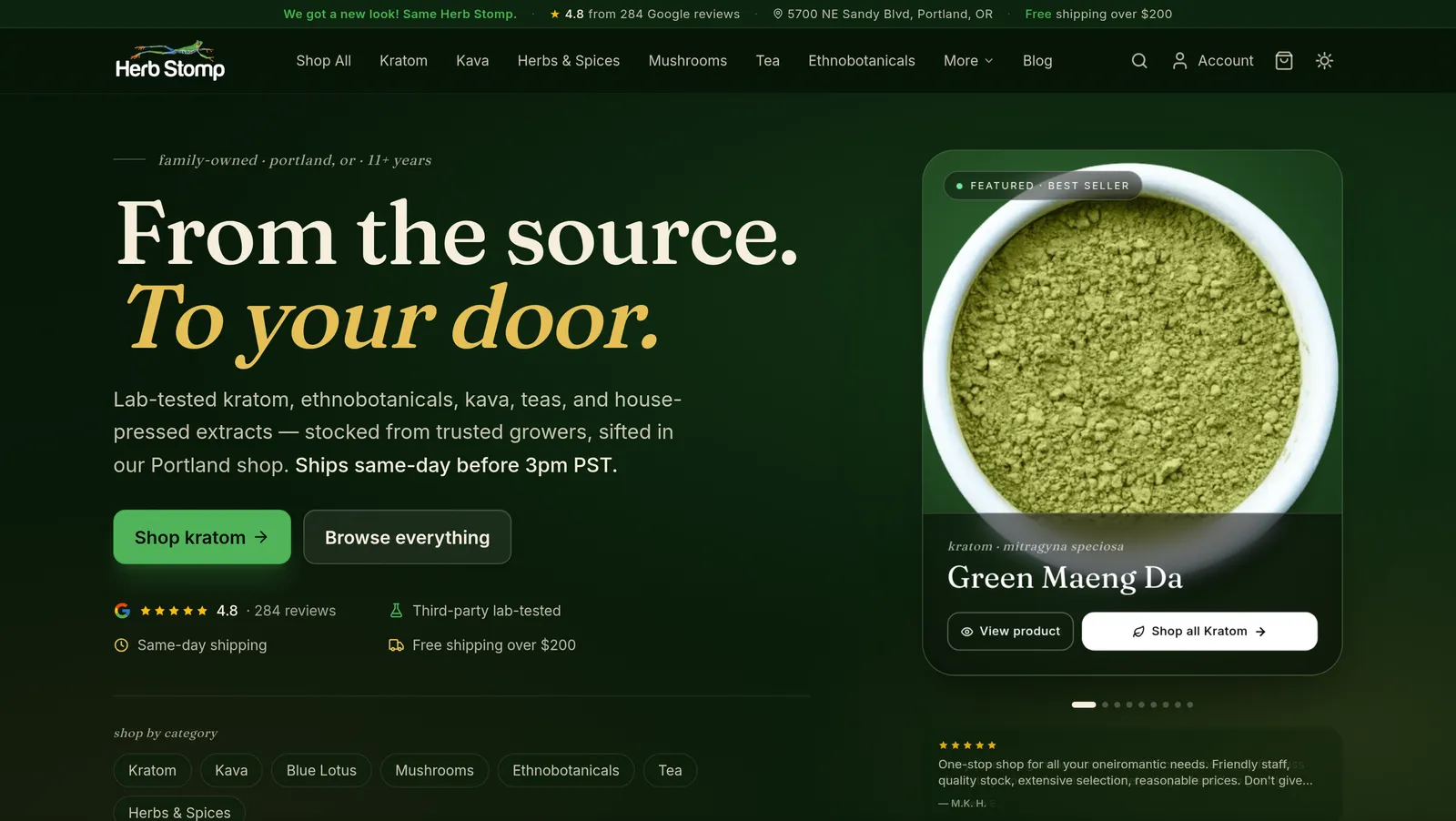
Same shop, same "From the source. To your door." line. Everything else rebuilt from scratch. Click either to enlarge.
Selling botanicals online is harder than selling almost anything else. The products are regulated, so you can't make health claims or talk about dosing without putting your payment processor and your ad accounts at risk. Customers want to actually understand what they're buying, so a bare product grid with a price and an Add to Cart button doesn't cut it. And the whole category is crowded with stores that look like they were built in 2014 on a WooCommerce theme with fifteen plugins bolted on.
Herb Stomp had the hard part figured out already. Eleven years running a real shop in Portland, lab-tested kratom, kava, mushrooms, teas, and ethnobotanicals, same-day shipping, 284 reviews at 4.8 stars. What they didn't have was an online store that carried any of that weight. The kind of customer who reads a full guide on damiana before buying it had nowhere to do that, and nowhere to buy it from once they were convinced.
So this was two problems in one. Build a store that can sell products people need to research, and do it in a way that stays on the right side of the rules that govern this category. Then build the SEO to bring in the people searching for these plants in the first place.
The whole storefront is hand-built on Astro with a headless WooCommerce backend, so the catalog, orders, and inventory run on software Herb Stomp already knows, while the front end is fast, custom, and ours to shape. No page builder, no theme, no plugin sprawl. Category pages have real copy and faceted filters. Product cards carry their variants right on the tile. And the pages load fast on a phone, which is where most of this traffic is.
Take the kratom page. It opens with a real intro on what the product is, how it's tested, and how it ships, the kind of copy a search engine can actually use, then hands you a grid of 16 strains you can filter by vein or narrow to what's on sale. Best sellers like Green Maeng Da, White Maeng Da, and Red Bali sit up top, and every card shows powder and capsule sizing inline, so you're picking a 4 oz bag or an 8 oz without a single extra click. Kava, mushrooms, tea, herbs and spices, and ethnobotanicals each get the same treatment.
The things that make people click buy on a botanical store are the things that are usually buried: third-party lab testing, ODA and GMP handling, same-day shipping before 3pm Pacific, free shipping over $200, an actual storefront address in Portland. On Herb Stomp those sit at the top of the page and on the product itself, not three scrolls down in a footer nobody reads.
This is the part that connects the editorial work to the catalog. Most stores treat content and commerce as two separate things: a blog over here, a shop over there, and a customer who has to find their own way from one to the other. Herb Stomp doesn't. The guide and the product are wired together, so the moment someone is interested, the thing they want is already right there.
Herb Stomp has 37 long-form guides, the kind with sources and footnotes, on things like damiana tea, kava, and blue lotus. On a normal store, a guide like that is a dead end. Someone reads 1,500 words, gets interested, and then has to go dig through the nav to find what they just read about. Most of them don't bother.
So we pinned a "Products in this guide" panel next to every article. Read the damiana piece and Damiana Leaf, Wild Dagga, and Kanna are sitting right there with their real prices, one click from the cart. The reader never has to leave the page that just convinced them.
Same idea on the product pages. Because people research these plants, every product has a full write-up: what it is, where it comes from, how it's sold, storage, a spec table, links to related botanicals. On most stores that pushes the Add to Cart button way down below the fold.
Here the buy box is a sticky column. You can read all the way through the botanical name, the family, the origin, the storage notes, and the price and size selector stay locked to the side the entire time. The product is buyable at every scroll position, not just the top. That is the two-column layout doing real work: the thing you're reading about is always the thing you can put in your cart.
The content approach centers on the products: botanical identity, sourcing, storage, history, and available formats. The store needs enough detail to help people understand the catalog without turning a product page into medical advice.
We built that editorial approach into the page templates, with educational context and clear product information alongside the buying options. The guides explain the plants and link to the catalog. The product pages give shoppers the details they need to compare what the shop carries.
Our ongoing ecommerce SEO work builds on a store that is already attracting more search traffic. We connect the searches people make with the right category, product, or guide, then keep those pages linked to each other. The Wild Dagga guide, the kratom category, and individual product pages are all gaining Google clicks. That gives us specific pages and search behavior to build on as the program continues.
Researched Guides
37Cited long-form, each wired to products
Kratom Strains
16Filterable by vein, all lab-tested
Google Rating
Real reputation to build the SEO on
Product Schema
100%Product, Breadcrumb, and FAQ markup
A static-first storefront that ships almost no JavaScript by default. Product and category pages load fast on a phone, which is where most botanical shopping happens.
The catalog, pricing, and inventory live in WooCommerce, so the shop runs on tools the team already knows. The custom front end pulls from it without inheriting the theme bloat.
Guides and products are linked in both directions. Every guide surfaces the products it mentions, and every product links back to the reading that supports it.
Product, BreadcrumbList, and FAQ structured data so Google understands the catalog, the categories, and the guides without guessing.
Served from Cloudflare's global network, with a light and dark mode that both stay on brand and a store that's quick no matter where the customer is.
The disclaimers and the no-health-claims framing are part of the template, not something a copywriter has to remember on every page. The shared templates keep that framing consistent across the catalog.
The quickest way to get how this store works is to click through it. Start with a category, or jump straight to one of Herb Stomp's best sellers and watch the buy box follow you down the page.
Best Sellers
Herb Stomp spent 11 years earning a reputation in Portland that most online stores in this category would kill for. The job was to build them a store that matched it, and to do it in a category where a wrong sentence can get you shut down.
The store is live, the content is connected to the catalog, and ongoing SEO is bringing more people into both. Google clicks rose from 1,508 to 3,166 across equal 28-day windows. We’re continuing the work on the categories, products, and guides behind that growth.
That's exactly the kind of store this approach is built for. Let's talk about a custom ecommerce site where your content does the selling.
Start Your Project