A Citation-Grade Authority Site for the Mechatronics Education Niche
We designed and built MechatronicsPrograms.com to be the reference somebody else cites. Every page has an obvious reason to be linked: a Texas bachelor's ranking a community college can point to, an ABET-EAC vs ETAC guide a university advising office links when it explains accreditation, and BLS-backed robotics engineer salary data a reporter can quote without checking it twice.
The Challenge
Mechatronics is one of the most confusing fields a prospective student can research, and the search results make it worse. Type "best mechatronics programs" and you get the same two things: college marketing pages that swear every program is the best in the country, and affiliate sites recycling a generic top-10 list that hasn't been touched since 2021. Nobody answers the question that actually matters.
That question is the fork in the road. Mechatronics splits into two completely different careers. A two-year associate degree or certificate puts you on the technician track, where the median wage sits around $73,900. A four-year ABET-EAC accredited bachelor's puts you on the engineer track, opens the path to a PE license, and pays $100K to $130K depending on the specialty. Pick the wrong accreditation and you can spend four years on a degree that quietly closes the door to licensure. Most sites in the space do not even mention the difference between ABET's two commissions, EAC and ETAC, which is the single most expensive thing a student can get wrong.
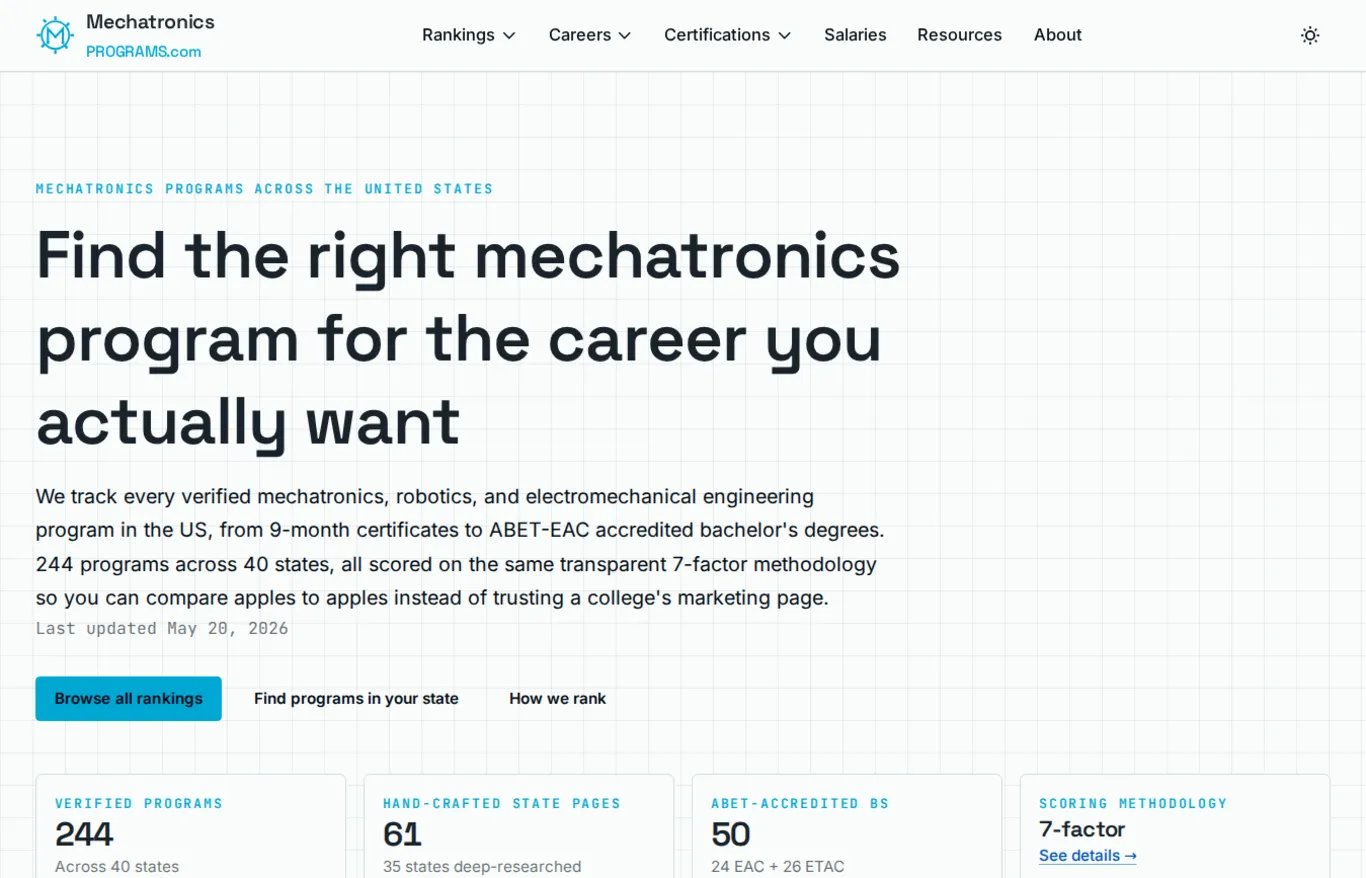
So we built the thing that didn't exist: a consumer-friendly directory of every verified mechatronics, robotics, and electromechanical engineering program in the country, scored against one transparent methodology, with the accreditation status spelled out, the wage data pulled straight from the BLS, and an opinion about which path fits which person. The kind of resource a college program director links to when they want to show how their program stacks up.
Our Solution
We built MechatronicsPrograms.com as a four-pillar authority asset: a state ranking directory, a degree-level comparison layer, a certification track that covers both the technician and engineer paths, and a BLS-backed wage section. 244 verified programs across 191 schools, all scored the same way. Every page is structured to earn links from the people who already write about this field, which is community college program directors, workforce boards, manufacturing employers, and the advising offices that steer students toward (or away from) the right accreditation.
State Ranking Directory (the linkable spine)
The core of the site is a state-by-state ranking, split by degree level so a searcher lands on exactly the page they need. The Texas bachelor's ranking contrasts the ABET-ETAC program at Texas A&M against the ABET-EAC track at Stephen F. Austin and names the actual employers hiring graduates, Samsung Austin, Tesla, Lockheed Martin in Fort Worth, Bell Helicopter. The California, Michigan, and Ohio pages work the same way. 61 hand-researched state pages in total, spanning 40 states across the certificate, associate, bachelor's, and master's levels.
This is the architectural reason the site earns links. A national top-10 list is one URL fighting a hundred others for the same query. A state directory is dozens of separately linkable pages, each one relevant to a different set of schools, employers, and workforce boards. The states index ties them together.
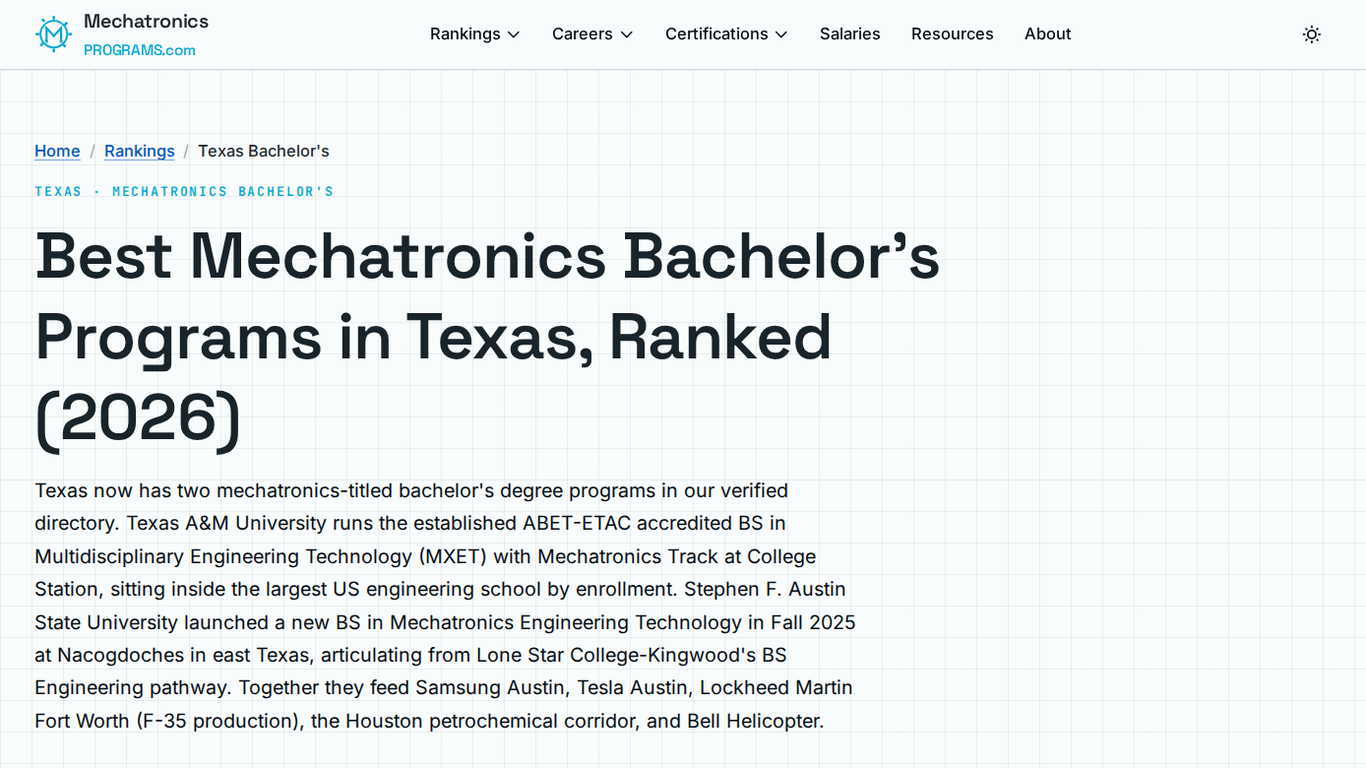
The Texas bachelor's ranking, one of 61 state pages, each individually linkable. State pages are the strongest backlink magnets because they map onto how schools and workforce boards already organize their information.
Degree-Level and Best-Of Pillars
Above the state grid sits a degree-level layer for searchers who lead with format or budget instead of geography. The best online mechatronics programs ranking captures the modality-first searcher across all four degree levels, the most affordable mechatronics programs page captures the cost-first searcher, and the mechanical engineering rankings cover the adjacent vertical that prospective mechatronics students almost always compare against.
Every pillar page links down into the state directory and across into the salary and certification tracks, so when an external site links one of these head-term pages, that link equity has a clear path through the rest of the spine.
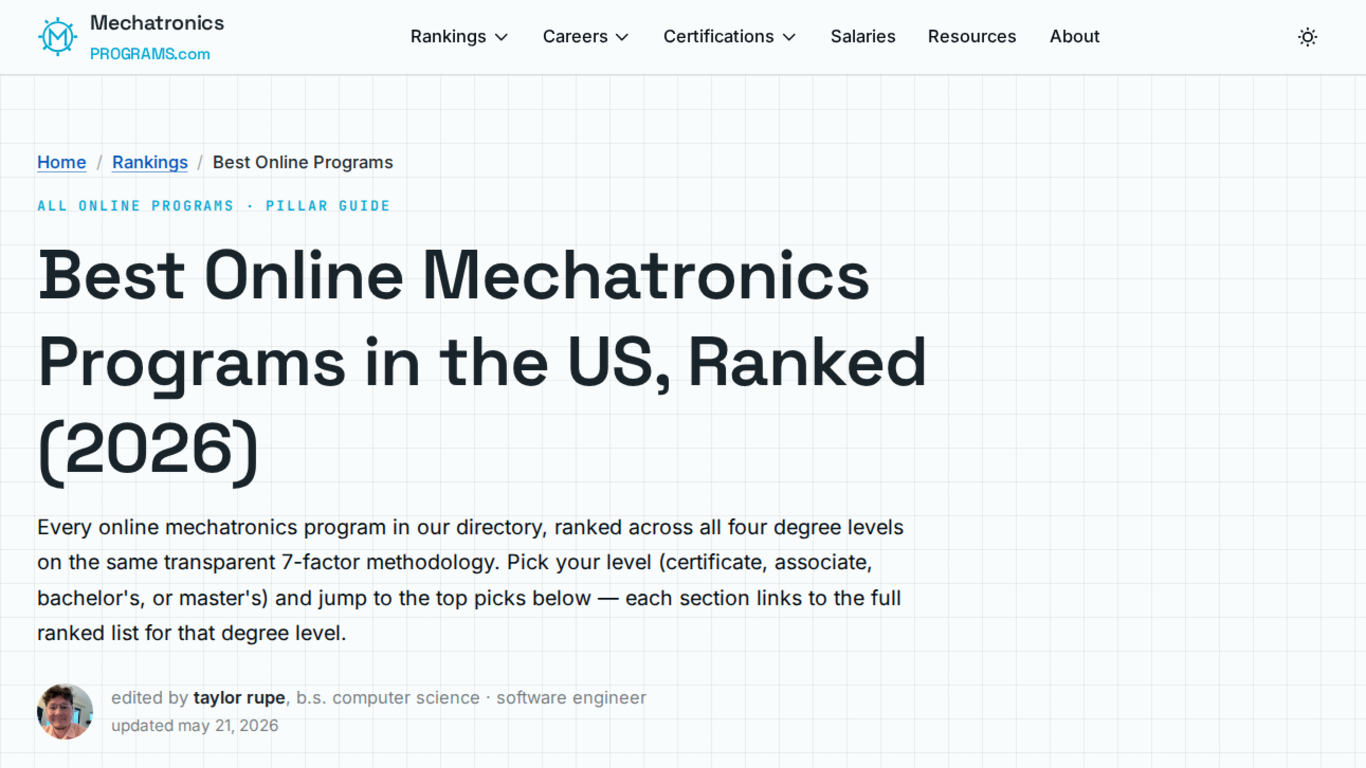
The best online mechatronics programs ranking, scored across all four degree levels on the same 7-factor methodology. This is the page distance learners and career-changers cite most.
Accreditation and Certification Authority
The ABET-EAC vs ETAC guide is the page that gets cited from inside academia. It explains, in plain language, why EAC accreditation opens the PE-licensure path and ETAC marks the technologist track, and why that one distinction should drive the whole decision. That is exactly the kind of explainer a high school counselor or university advising office links to. On the credential side we cover both career tracks: the FE exam and PE exam for the engineer path, and the MSSC CPT, Siemens SMSCP, ISCET CET, and PMMI mechatronics credentials for the technician path.
The whole thing rests on the scoring methodology: a 100-point scale built from seven weighted factors, with accreditation carrying the most weight. Same model applied to every program, no editorial override, no pay-for-placement. Publishing the formula is itself a trust signal, because editors link to sites that show their work.
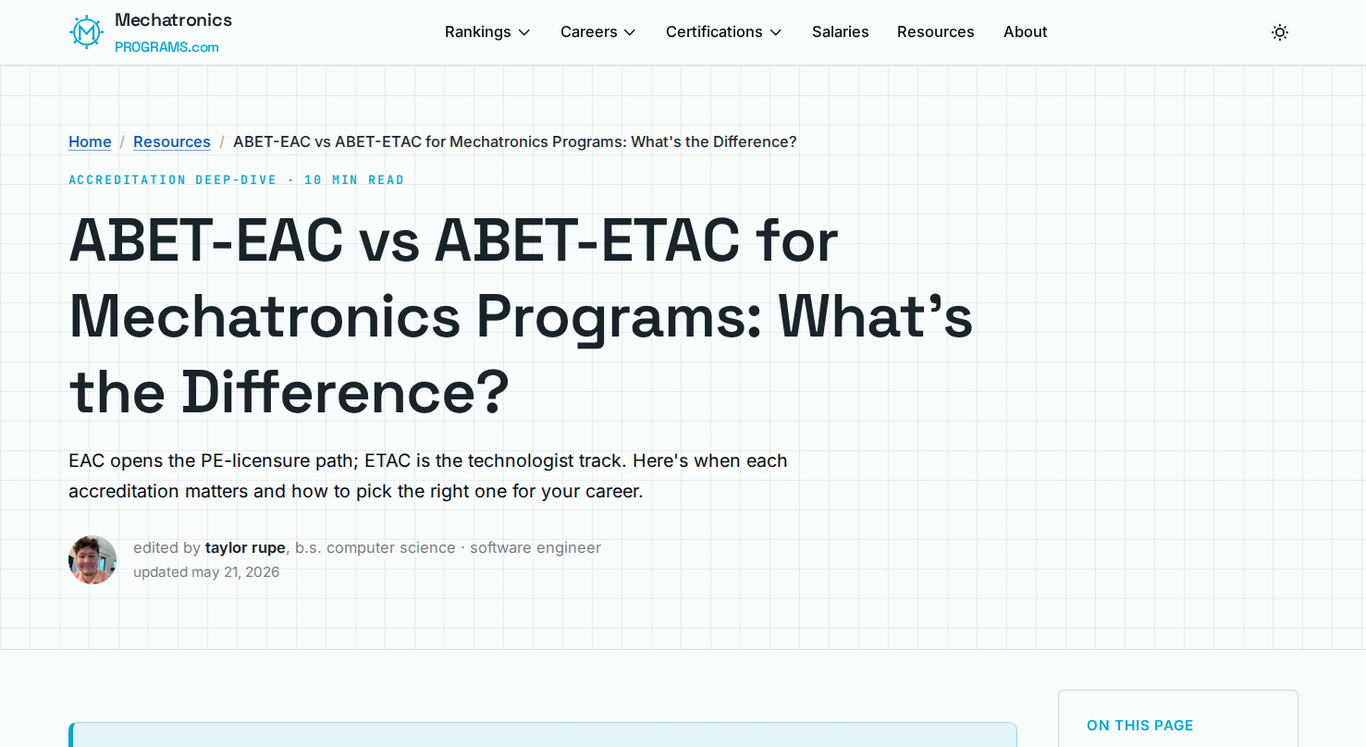
The ABET-EAC vs ETAC guide. Author byline, read time, and a one-sentence answer above the fold. These are the trust signals an editor looks for before linking to a domain they don't know.
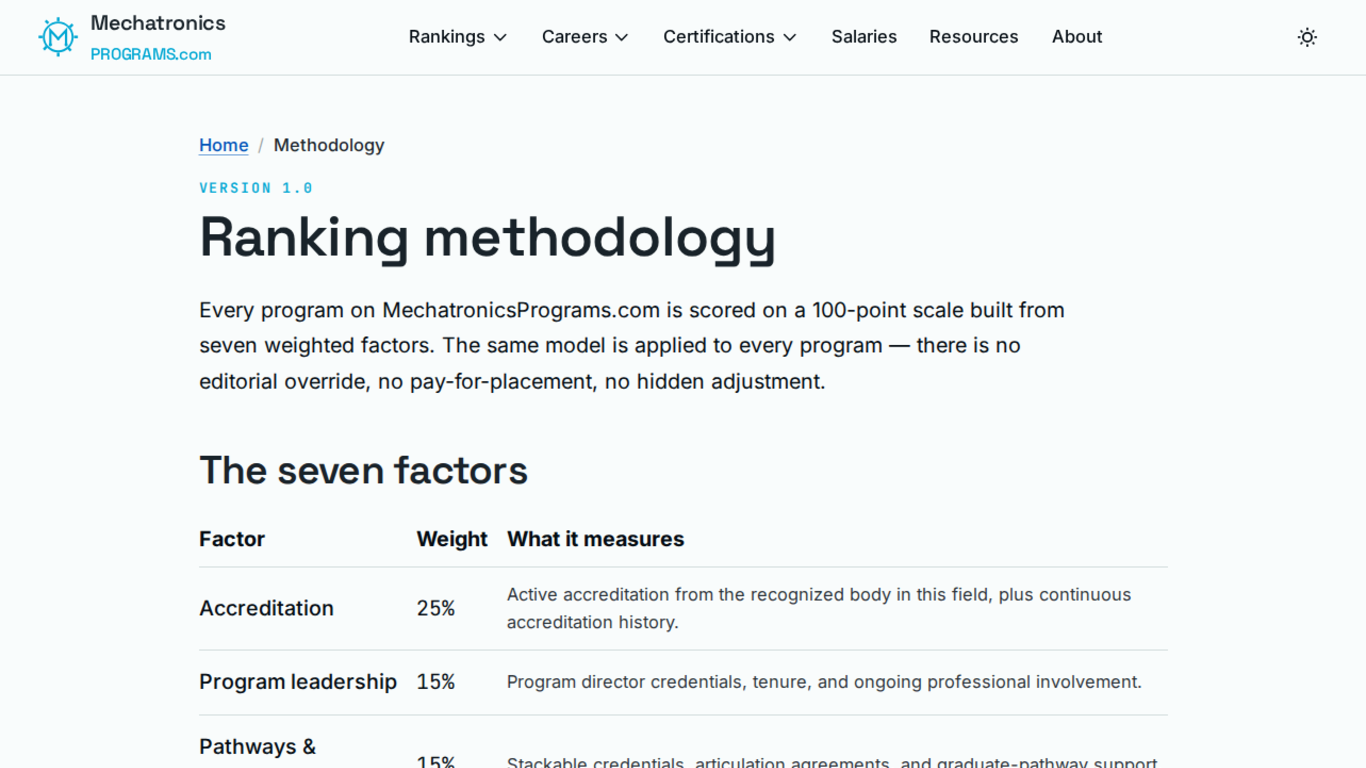
The methodology page. Accreditation 25%, program leadership 15%, pathways 15%, delivery 15%, employer signal 15%, cost 10%, reputation 5%. The weights are public, so the rankings are defensible.
BLS-Backed Wage Data (the journalist magnet)
The salaries section covers nine career tracks, each built from primary BLS OEWS data with the full percentile distribution rather than a lone median number. It splits cleanly along the same technician-vs-engineer line the rest of the site is organized around: the mechatronics technician tier at roughly $73,900, and the engineer tier covering the robotics engineer, controls engineer, automation engineer, mechanical engineer, and electrical engineer roles.
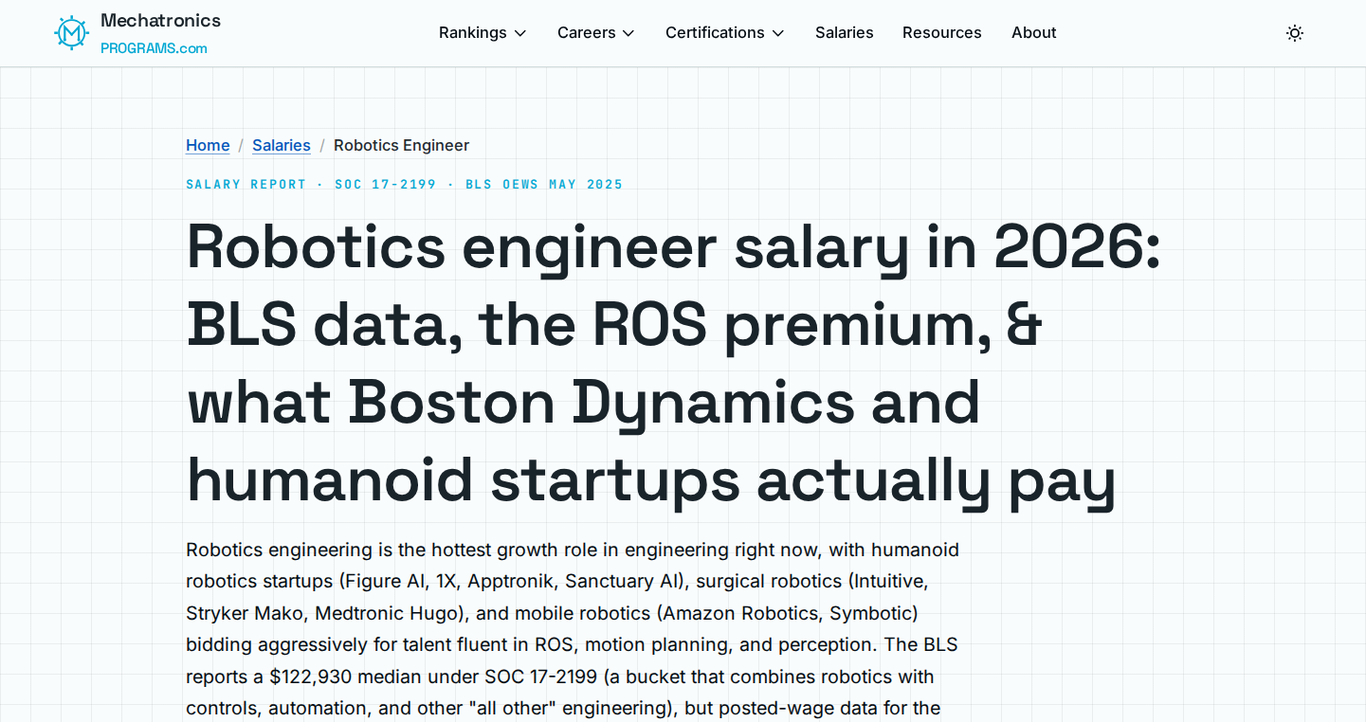
Salary content is the most-cited category in any career niche, because journalists and HR writers almost always need a number attached to a job title. The robotics engineer page goes further than the BLS median and explains the ROS premium and what humanoid-robotics employers like Boston Dynamics and Figure AI actually pay, which is the detail that gets the page quoted.
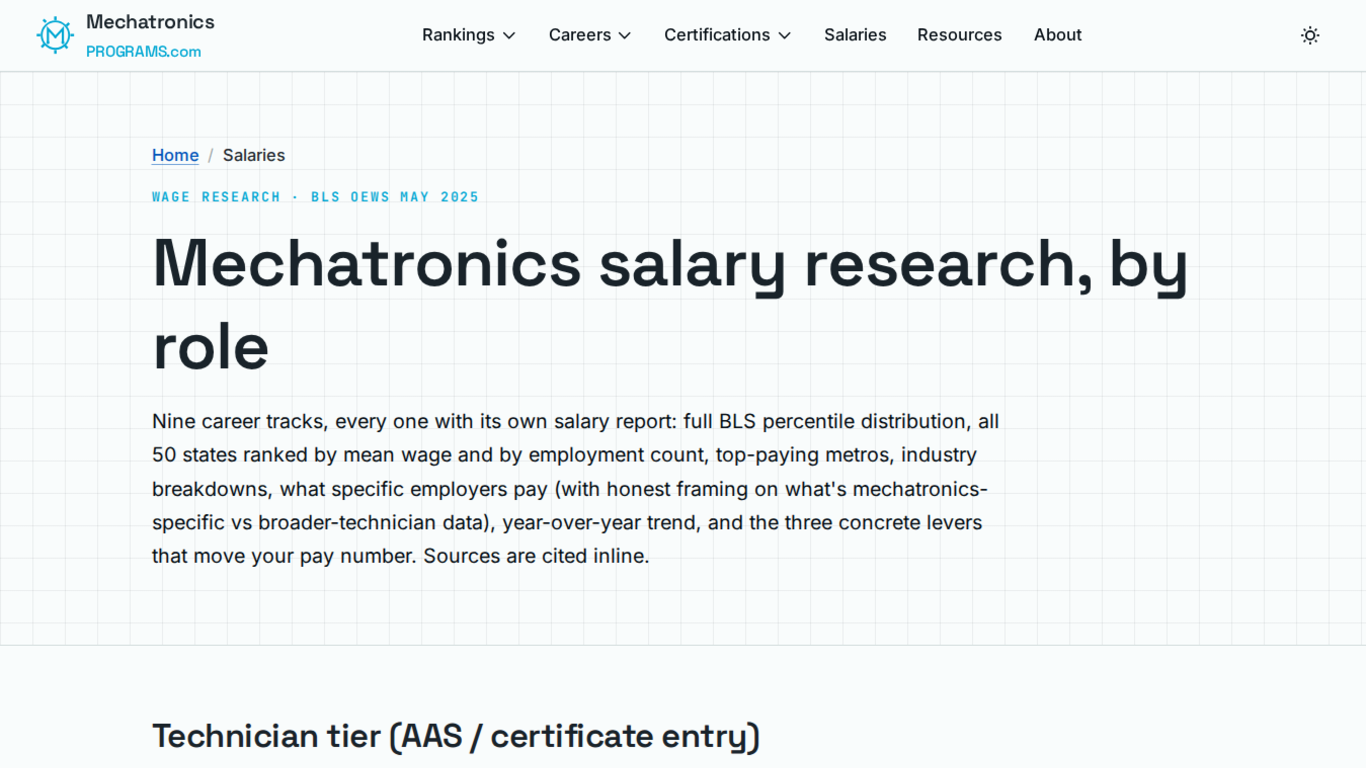
The salary hub. Every figure is BLS OEWS May 2025 data, cited inline, which makes the page safe for an editor to reference without re-checking the numbers from scratch.
Editorial Design That Reads Like a Publication
The design is a deliberate break from the affiliate look that dominates this niche. Clean technical type, a single accent color, and a layout that puts the data first. Every page leads with a real author byline, a visible last-updated date, a read time, and a short summary up top. Citations to the BLS, ABET, and O*NET are linked inline like footnotes, not dressed up as affiliate buttons.
This matters for getting links because an editor at a .edu or .gov referring site sizes up your credibility in about three seconds. A page that looks like a real publication clears that bar. A page that looks like a lead funnel doesn't, no matter how good the underlying research is.
Performance and Schema for Discoverability
MechatronicsPrograms.com is built on Astro with static generation and deployed to Cloudflare Workers, so every one of its 517 pages is pre-rendered HTML served from the edge. No client-side framework, no hydration, no JavaScript bundle to download before the content shows up. Core Web Vitals are green across every template, which matters because slow pages don't earn links and don't survive the manual look an editor takes before quoting a source.
Every page emits Schema.org JSON-LD: Organization, Article, BreadcrumbList, CollectionPage, FAQPage, and Person for the author. That structured data is what surfaces the site inside Google's AI Overviews and tools like Perplexity, which is increasingly where new editorial citations start.
The Anchor-Text Strategy
Most authority sites get built and then someone asks, "okay, now what do we link to?" We worked backward. We mapped the anchor text we wanted to be able to use, then built the page each anchor points to. The result is a site where every editorial mention has an obvious, on-topic home.
Geographic anchors
"Best mechatronics programs in Texas," "California mechatronics bachelor's ranked," "Ohio mechatronics associate programs." 61 state pages across four degree levels means 61 unique anchor opportunities for the schools and employers in each state.
Decision-stage anchors
"ABET-EAC vs ETAC," "mechatronics vs mechanical engineering," "is a mechatronics degree worth it." Comparison and explainer pages are the most-linked single URLs in any niche, because each one captures a whole keyword cluster and answers a question people ask out loud.
Salary anchors
"Robotics engineer salary," "controls engineer pay," "mechatronics technician salary." Wage anchors are the ones journalists and HR bloggers reach for most, because they almost always need a real number to cite.
Credential anchors
"FE exam," "PE licensure," "MSSC CPT certification." Credential anchors map to evergreen pages that don't need a quarterly refresh, and they cover both the engineer and technician audiences at once.
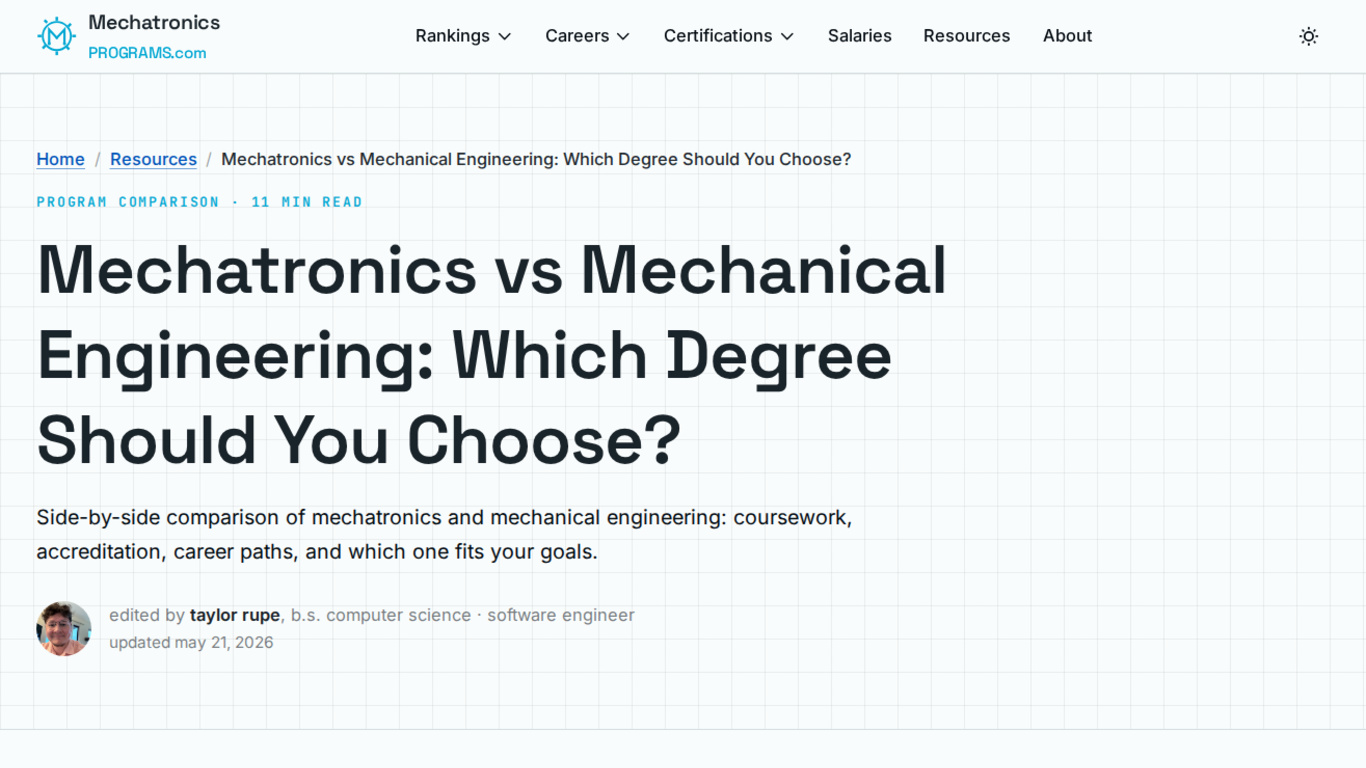
The mechatronics vs mechanical engineering comparison. Side-by-side decision pages pull citations because they settle a question in one place instead of scattering it across ten.
Technology Stack
The Results
MechatronicsPrograms.com launched with the full spine in place: 244 verified programs across 191 schools, 61 state ranking pages, both career tracks documented end to end, and BLS wage data for nine roles. It's engineered to compound, not spike. Every new program added, every accreditation refresh, every new state page widens the surface area for editorial links.
244 verified mechatronics, robotics, and electromechanical programs across 191 schools, all scored on one 7-factor methodology so they can be compared apples to apples.
61 hand-researched state ranking pages across 40 states and four degree levels, each one an individually linkable anchor target for its local schools and employers.
An ABET-EAC vs ETAC guide plus full FE/PE and MSSC/SMSCP/ISCET credential coverage, mapping both the engineer and technician paths the field splits into.
BLS-backed salary data for all nine roles with full percentile distributions, presented so the charts are quotable for journalists and HR writers.
Sub-second page loads across all 517 pages, green Core Web Vitals, and full Schema.org JSON-LD so the site is surfaced inside AI overviews and generative search.
The bet behind a project like this is simple. An asset built deliberately, with the anchor text mapped first and the editorial credibility treated as a feature instead of an afterthought, compounds in a way no single page can. The state directory is the moat. The ABET guide is the one academia cites. The salary data is the journalist magnet. And the design is what makes a .edu editor comfortable linking. Each layer feeds the others.
Need a Site That Earns Links Instead of Buying Them?
We build authority assets where the anchor text is mapped first, the content is engineered to be cited, and the editorial design makes editors comfortable linking.
Start Your Project