$5.6M of organic traffic value.
As a startup, against the credit bureaus.
SEO Manager at Credit Sesame from August 2011 to October 2012, then continued as their outside consultant for another year after starting the agency. The site went from a fledgling startup with little organic visibility to ranking top 5 for "free credit score", outranking Experian, Equifax, TransUnion, and most of the major banks.
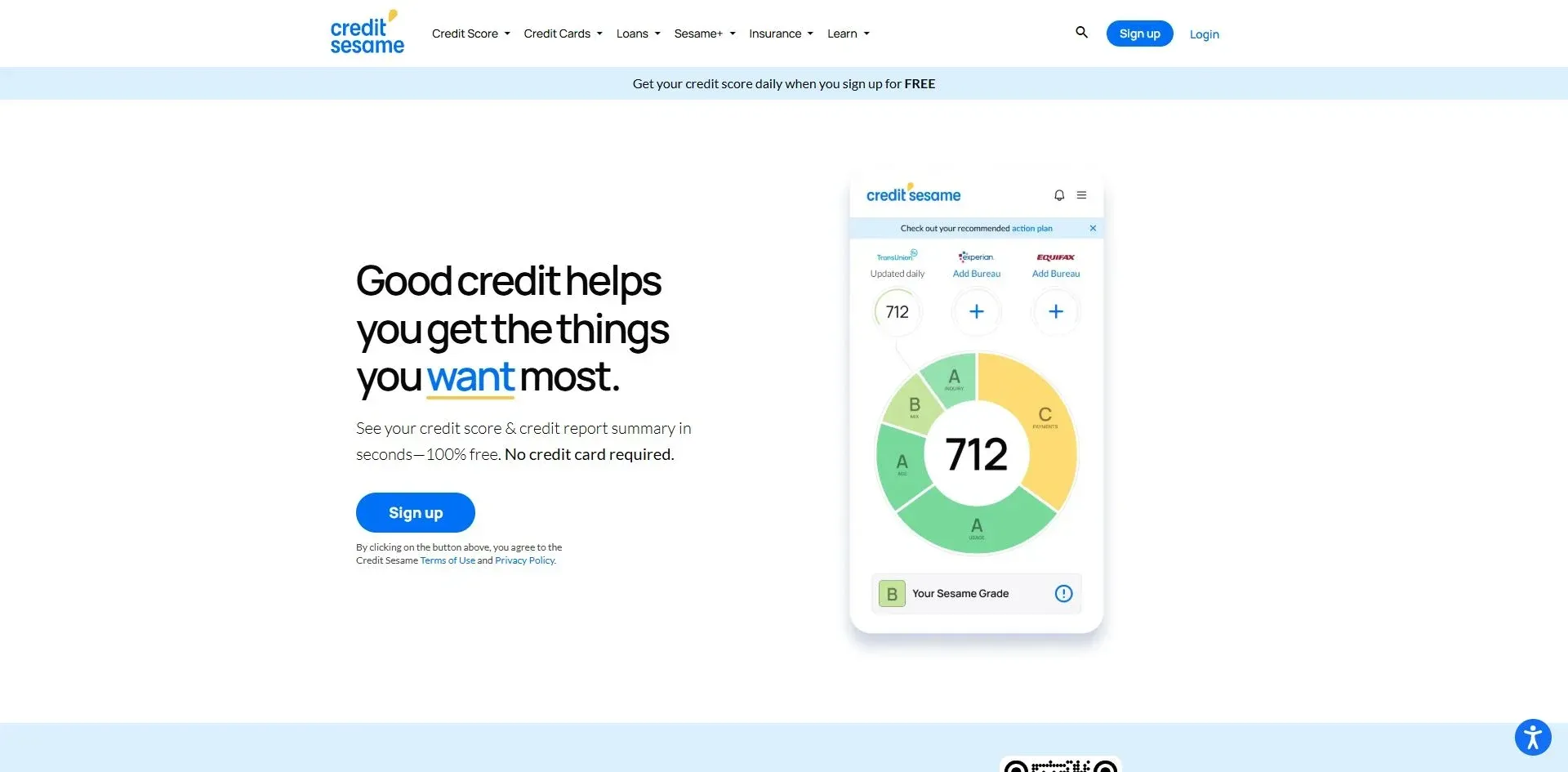
The Challenge
Credit Sesame was a Silicon Valley FinTech startup going after one of the most competitive keyword spaces in all of search: "free credit score." The companies already ranking for that term included Experian, Equifax, TransUnion, NerdWallet, Credit Karma, and every major bank you can think of. These aren't just competitors with good SEO teams. They're institutions with decades of domain authority, massive link profiles, and effectively unlimited content budgets.
Credit Sesame had a relatively new domain, minimal brand recognition, and the kind of budget constraints that come with being a startup. Paid acquisition was expensive in the financial services space, with cost-per-click for credit-related keywords running $15 to $40+. Organic search was the most cost-effective path to sustainable growth, but breaking through against these incumbents required a very deliberate strategy.
This wasn't a project where we could just optimize a few title tags and build some links. The scale of competition meant we needed to think about site architecture, topical authority, and content strategy at an enterprise level from day one, even though the company was still a startup.
Our Approach
The role covered the full SEO program: technical foundations, site architecture, content strategy, link acquisition, and ongoing reporting. Every decision had to be designed for a long-term assault on terms held by century-old institutions.
Technical Foundation
We started with the technical fundamentals. Site structure, URL patterns, internal linking architecture, and schema markup all needed to be right from the beginning. At the scale Credit Sesame was aiming for, with potentially thousands of pages, any structural mistakes early on would compound and become extremely difficult to fix later.
We implemented comprehensive structured data markup across product pages, editorial content, and FAQ sections. We established clean URL hierarchies that would support the content hub model we planned to build out. Crawl budget optimization was important too, since we needed Google spending its time on the pages that mattered most.
Content Hub Strategy
The core of the strategy was building topical authority across the entire credit score ecosystem. We mapped out content hubs covering credit scores, credit monitoring, credit cards, credit repair, and personal finance. Each hub had pillar content supported by dozens of related articles that internally linked back to the core pages.
The keyword targeting was layered. We identified hundreds of long-tail opportunities where we could win quickly, and those wins built the domain authority needed to compete for the bigger head terms. Every piece of content was planned to serve a specific purpose in the broader topical map. Nothing was published just for the sake of having more pages.
Scalable Architecture
We designed the site architecture to handle significant content expansion without diluting the SEO equity of core pages. This meant careful planning around subdirectory structures, canonical tags, pagination, and internal link distribution.
The architecture was built for where Credit Sesame was going, not just where they were at the time. The framework supported scaling from a few dozen pages to thousands while maintaining clear topical relevance signals for search engines. That scaffolding kept paying off long after the engagement ended. By 2018 the site was ranking for over 165,000 keywords and pulling in over 700,000 monthly organic visitors.
From $41K/month in traffic value
to $658K/month.
Across the 22-month engagement that Semrush has data for, Credit Sesame's organic traffic value grew from $41,389/month to a peak of $657,758/month, and accumulated $5.6M+ in equivalent Google Ads value while ranking against the credit bureaus and the country's largest banks for terms that cost upwards of $15 per click in paid search.
The engagement actually started in August 2011, but Semrush's archive only reaches back to January 2012, so the 22-month window shown reflects the data available, not the full engagement length. The earlier months are conservatively excluded.
Engagement
~26 moAug 2011 → Oct 2013
Cumulative Traffic Value
$5.6M+Sum of monthly Google Ads equivalents
Peak Monthly Visitors
70K12.5× from earliest data point
Peak Monthly Value
$658K15.9× from earliest data point
Top 5 for "free credit score": against the bureaus
At its peak, the site was ranking in the top 5 organic results for "free credit score", the highest-volume, highest-CPC keyword in the consumer credit space. Sitting in those positions meant outranking Experian, Equifax, TransUnion, NerdWallet, and most of the major banks. For a startup with a relatively new domain, that's the SEO version of beating Goliath.
Organic Keywords Ranking
Search queries Credit Sesame appeared for in Google · Jan 2012 → Oct 2013
Estimated Monthly Search Traffic
Visitors arriving from organic Google searches
After the engagement, the foundation kept compounding.
Credit Sesame's internal team kept building on the SEO scaffolding we put in place. By Oct '14 (one year after consulting ended) the site was ranking for 5,702 keywords at 68,502 monthly visitors. By 2018 the site had grown to over 700,000 monthly organic visitors with peak monthly traffic value above $3.8M.
Credit for those numbers belongs to Credit Sesame's in-house team and the years of work that came after. They're shown here as evidence that the technical and architectural foundation we built scaled cleanly to enterprise levels.
The Credit Sesame engagement is the kind of work that happens once: getting in early on a Silicon Valley startup, owning the SEO program from the technical foundations up, and watching organic search become the dominant acquisition channel for a company that would later raise nine figures and reach unicorn-adjacent valuations.
The lesson isn't that any startup can outrank Experian. It's that a properly structured SEO program (built for where the company is going, not where it is) produces results that compound for years. That's the playbook this case study is really about.
Competing Against Giants?
Smart SEO strategy can level the playing field. Let's talk.
Start Your Project