Millions of pages indexed.
$49.6M in organic traffic value.
Senior SEO Analyst at FindLaw (Thomson Reuters) from November 2011 to January 2013. Drove organic improvement across the legal information portal and lawyer directory, including a sitemap implementation system that resulted in millions of pages getting indexed by Google.
The Challenge
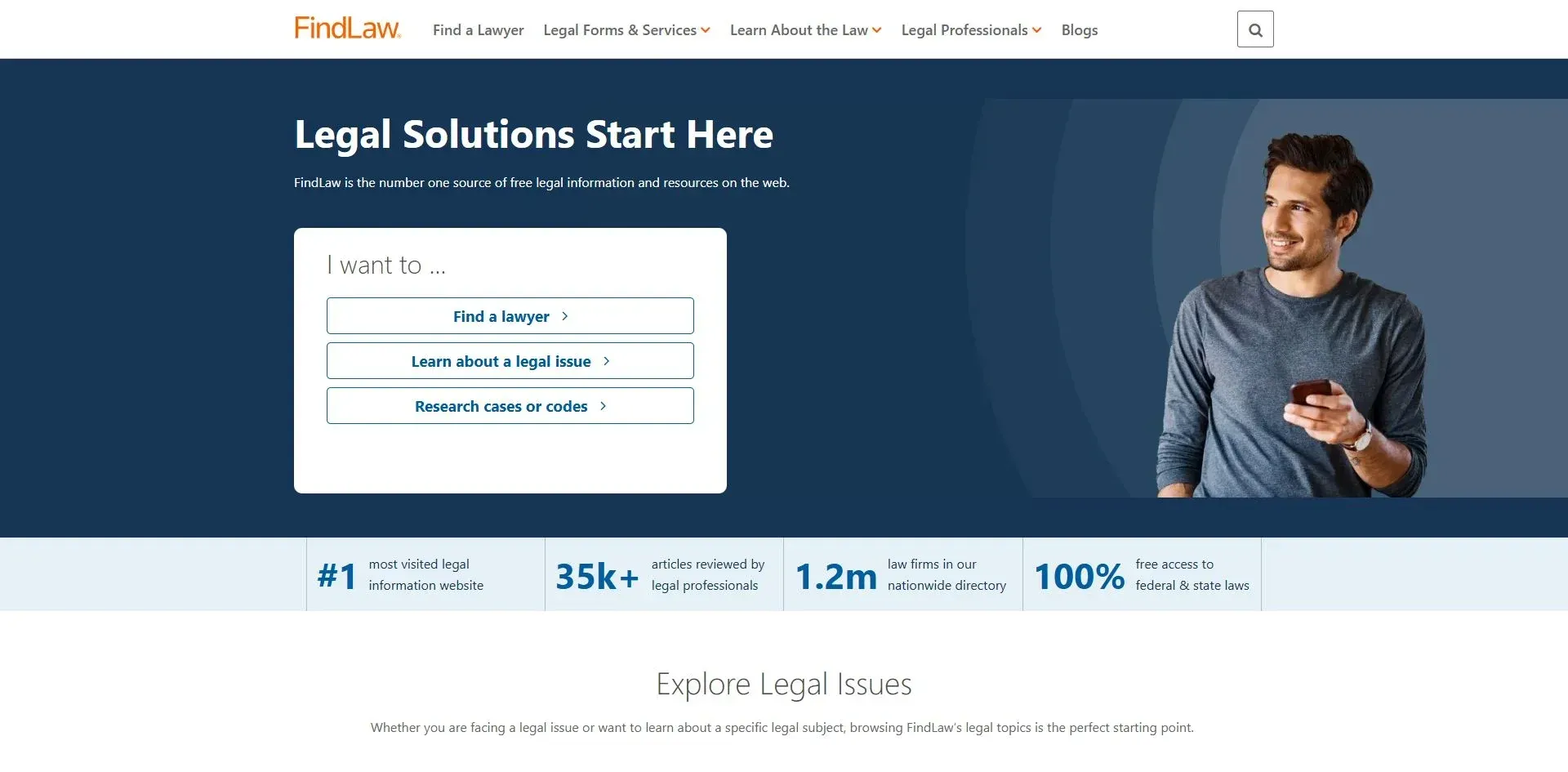
FindLaw operates a massive website combining a comprehensive legal information library with an extensive lawyer directory. Their business model depends on lawyer subscriptions and marketing engagements, which requires dominating search results for thousands of high-value, locally-focused legal keywords. The scale is enormous: every "lawyer + city" combination across the country, every legal practice area, and a deep library of legal articles.
A site this large comes with problems smaller sites never have to think about. Crawl budget becomes a real constraint when Google can't index your full site in a single pass. Internal linking at this scale is more like infrastructure engineering than traditional SEO. And the engagement happened during one of the most turbulent periods in Google's history. Panda iterations and the original Penguin update both landed during the project, reshaping the rankings of every large content site overnight.
My role as Senior SEO Analyst was to drive organic improvement at this scale by partnering with FindLaw's product, content, and engineering teams on architecture, indexation, and the technical infrastructure that determines whether a site with millions of pages actually gets seen by Google.
The Project
The signature project of the engagement was a robust sitemap implementation system designed to solve the indexation bottleneck that comes with running a multi-million-page website.
The Sitemap System
When you have millions of URLs across a legal-content portal and a national lawyer directory, simply having those pages live isn't enough. Google has to discover them, decide which deserve crawl budget, and successfully index them. Without a proper sitemap infrastructure, large swaths of FindLaw's content (entire practice areas, cities, lawyer profiles) were either undiscovered, slow to refresh, or dropping in and out of the index unpredictably.
Working with the engineering team, we designed and implemented a sitemap system that segmented the site's URL space by content type and update frequency, generated and refreshed sitemaps programmatically, and surfaced the full inventory to Google in a way the crawler could actually consume. Each sitemap was scoped, prioritized, and tagged with last-modified data so Google could spend its crawl budget on what mattered most.
The result: millions of pages indexed that hadn't been before, and a foundation that scaled with the site as content was added.
Architectural & Technical SEO
Beyond the sitemap project, the analyst role covered the full enterprise SEO stack: site architecture strategy, internal linking distribution, schema markup at scale, canonical handling, pagination, and the kind of crawl-budget optimization where small percentage gains translate into thousands of additional indexed pages.
This kind of work is invisible to the end user, but it's what separates enterprise SEO from regular SEO. Getting the architecture right meant Google could efficiently process the site and rank the right pages for the right queries.
Navigating the Penguin / Panda Era
The engagement spanned directly through the original Penguin update (April 2012) and multiple Panda iterations. Both updates targeted exactly the kind of large-scale, programmatically-generated content that a site like FindLaw has to manage. Many comparable directories and content sites took heavy losses in this period.
Part of the work was triage and recovery: diagnosing which sections of the site were vulnerable to algorithmic scrutiny, working with content and editorial teams to strengthen quality signals, and adjusting the technical architecture to focus crawl and ranking signals on the highest-quality assets. The site sustained its position as one of the dominant legal portals through a period that flattened many similar properties.
$49.6M in cumulative organic value.
While Penguin reset the rankings.
Across the engagement window, FindLaw sustained between $2.7M and $5.6M in monthly organic traffic value: the kind of revenue equivalence that comes from operating at enterprise scale. Monthly traffic value grew from $3.9M to $5.6M (+43%) during the engagement, even as Google's Penguin and Panda updates reshuffled the rankings of every large content site on the internet.
The engagement actually started in November 2011, but Semrush's archive only reaches back to January 2012, so the 13-month window shown reflects the data available, not the full engagement length. The earliest 2 months are conservatively excluded.
Engagement
14 moNov 2011 → Jan 2013
Cumulative Traffic Value
$49.6M13 months of available data
Pages Indexed
MillionsVia the sitemap implementation system
Monthly Value Growth
+43%$3.9M → $5.6M during engagement
Why monthly value grew while raw traffic dipped
Penguin (April 2012) and the Panda iterations of 2012 both targeted exactly the kind of programmatic, large-scale content a directory like FindLaw operates. Raw traffic numbers fluctuated. That was happening across the entire industry. But the rankings that survived the algorithm updates were the higher-quality, higher-CPC commercial pages: lawyer profiles, practice area landing pages, and bottom-funnel content. By January 2013, FindLaw was generating $5.6M/month in equivalent Google Ads value, up 43% from where the engagement started. That's the part of the story most "traffic graphs" miss.
Monthly Organic Traffic Value
Equivalent monthly Google Ads spend to replicate FindLaw's organic search visibility
Organic Keywords Ranking
Search queries FindLaw appeared for in Google · 13 months
Estimated Monthly Search Traffic
Visitors arriving from organic Google searches
Working at FindLaw's scale is a different discipline than optimizing a single business website. Millions of pages, multi-million-dollar monthly traffic value, and Google's most consequential algorithm updates landing while you're mid-engagement. The work is less about ranking individual pages and more about engineering the systems (sitemaps, internal linking, crawl architecture, content quality signals) that determine whether a site at this scale gets seen at all.
The strategies and frameworks developed for FindLaw inform how we approach SEO challenges of all sizes today. When you've figured out how to move the needle for a site with millions of pages, through algorithmic turbulence, every smaller project benefits from that depth of technical understanding.
Have a Large-Scale SEO Challenge?
Indexation problems, crawl-budget issues, sitemap engineering. We've seen it. Let's talk.
Start Your ProjectWe run a dedicated law firm marketing site with hand-written pages, real keyword data, and industry-specific content: SEO for law firms.