A Citation-Grade Authority Site for the Health Information Management Niche
We built HealthInformationManagementPrograms.com as an editorial asset that exists to be cited. Every page is engineered to earn links: a Washington HIM ranking a community college can link from its program page, an associate degree ranking healthcare workforce boards can reference, and BLS-backed salary data journalists can cite without a second thought.
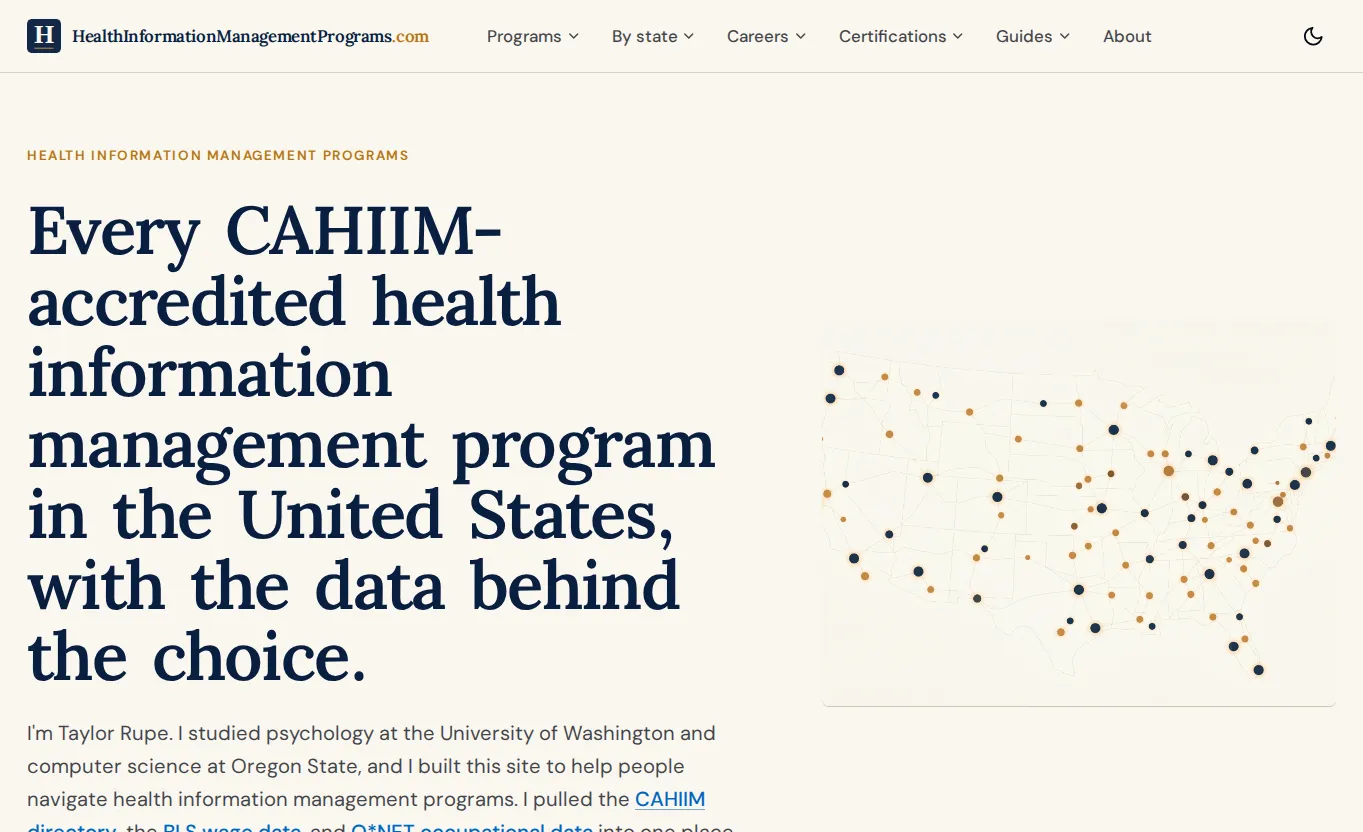
The Challenge
Health information management is a stable, growing career with real Bureau of Labor Statistics demand projections, but the search results for "best HIM programs" or "RHIA vs RHIT" are dominated by two flavors of low-effort content: AHIMA's official program list (a static, alphabetical table with no editorial layer) and a handful of affiliate-stuffed doorway sites that recycle the same generic top-10 lists year after year.
Real prospective students, plus the school admissions teams, librarians, and workforce-board researchers who refer them, were looking for something that did not exist: a consumer-friendly directory of every CAHIIM-accredited program in the country, scored against a transparent methodology, with verified accreditation status, BLS wage context, and an opinionated point of view about which programs are actually worth the tuition.
We wanted the kind of asset that other sites in the space would have no choice but to link to. Not a thin affiliate funnel. A reference resource. The page somebody links from a community college's HIM program page when they say "see how we rank against other CAHIIM-accredited programs in the state."
Our Solution
We designed and built HealthInformationManagementPrograms.com as a four-pillar authority asset: a 50-state ranking directory, a degree-level comparison hub, a certification authority track, and a BLS-backed wage and career section. Every page is structured to earn editorial backlinks from the people who already write about HIM careers: community college program directors, allied-health career counselors, hospital recruiting pages, AHIMA chapter blogs, and workforce-development boards.
50-State Ranking Directory (the linkable spine)
The core of the site is a 50-state HIM program ranking. Every CAHIIM-accredited program gets scored against the same seven-factor methodology and ranked head-to-head within its state. The Washington HIM rankings page covers 6 accredited programs and contextualizes them against Washington's $62K median wage and 5,010 HIM jobs in-state. The California rankings, Texas rankings, New York rankings, and Florida rankings work the same way. Each state page is its own backlink target. A school in Tennessee can link to the Tennessee rankings, an Oregon community college to Oregon's, and so on across all 48 states plus Puerto Rico.
This is the architectural reason the site earns links. A national "top 10" ranking has one URL competing against a hundred others. A 50-state directory has 50 specifically linkable pages, each one relevant to a different geographic community of referrers.
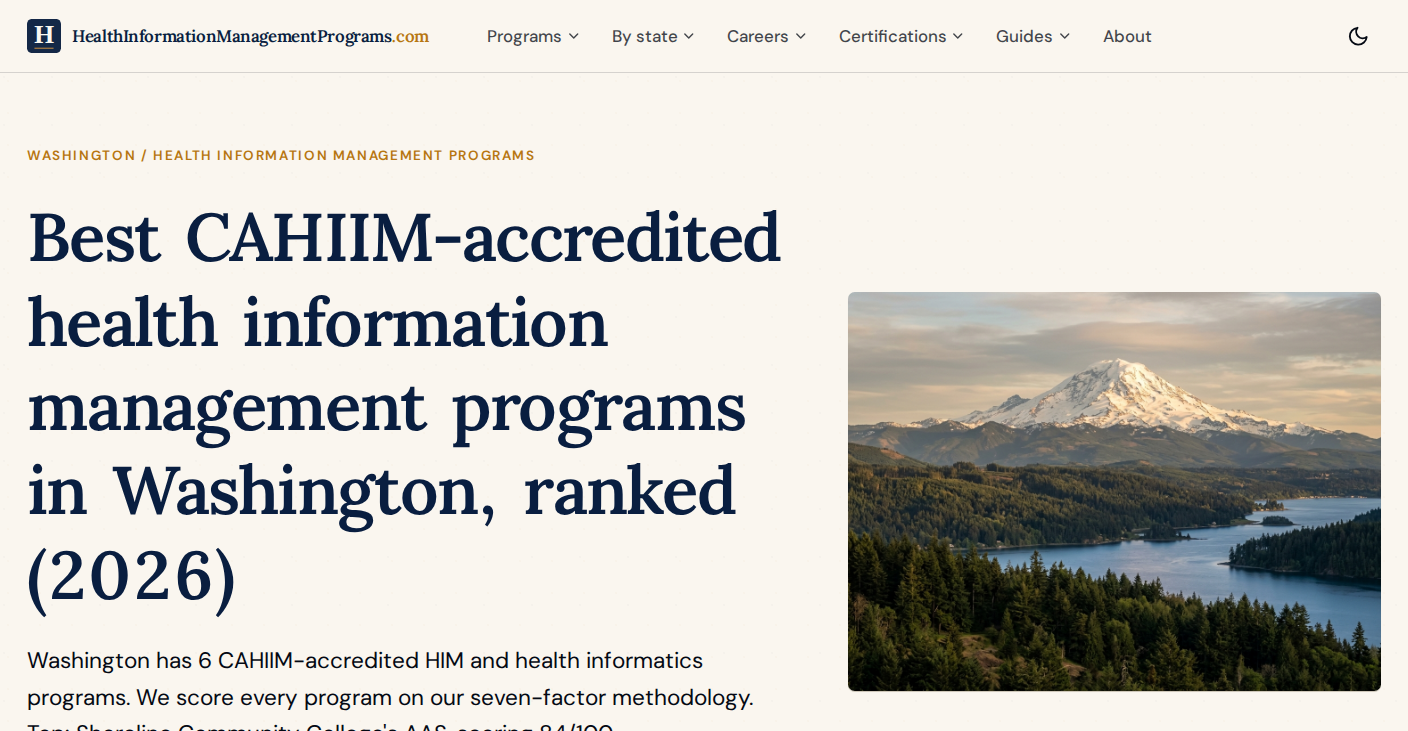
The Washington HIM ranking page, one of 48 state pages, each individually linkable. State-level rankings are the strongest backlink magnets because they map cleanly onto how schools and workforce boards already organize their information.
Degree-Level Pillar Pages
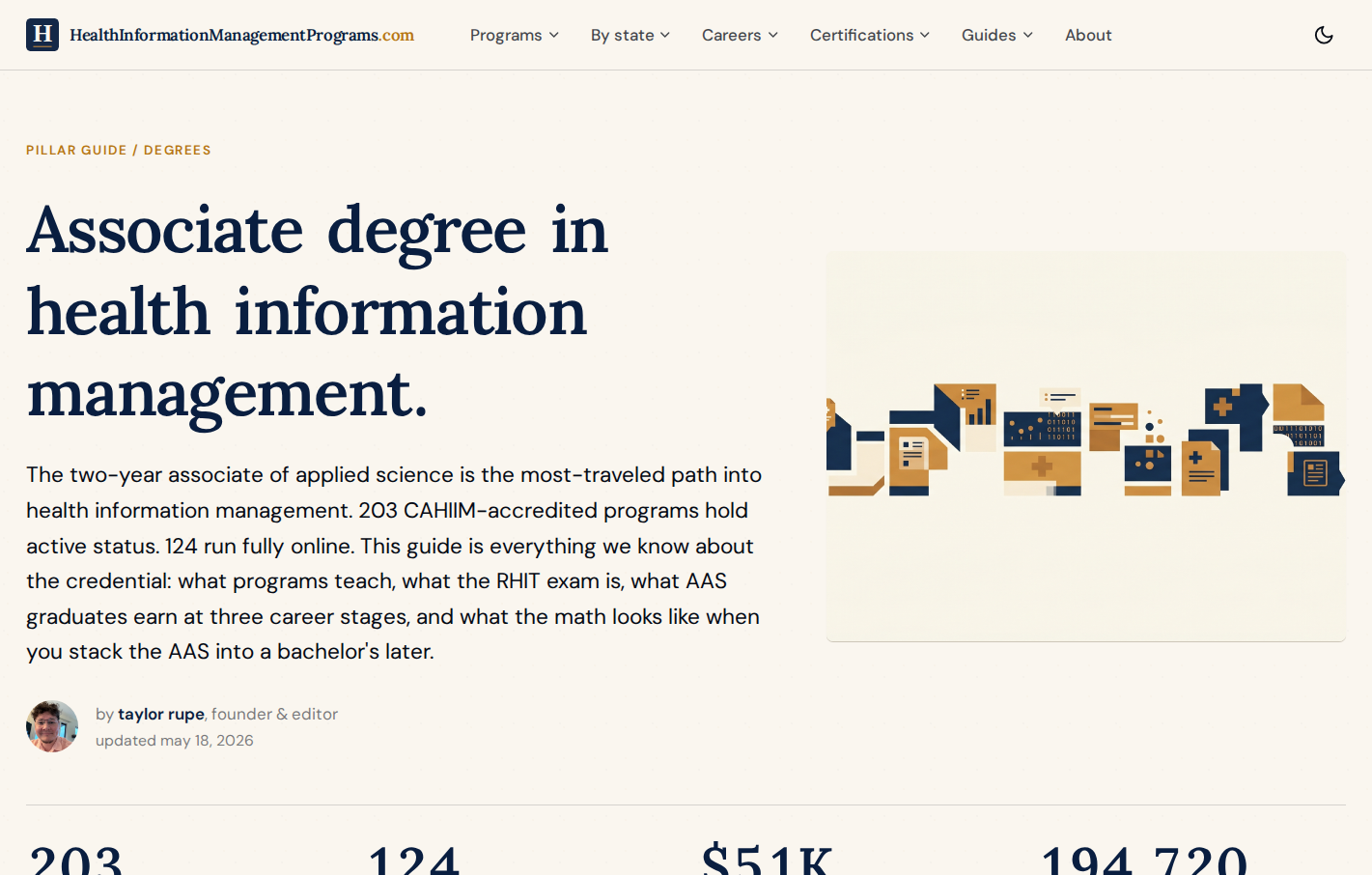
Above the state grid sits a degree-level layer. The associate degree in HIM ranking covers all 205 CAHIIM-accredited AAS programs in the country, the bachelor's in HIM page covers the bachelor's track, and the online HIM programs hub captures the modality-first searcher. The associate degree pillar is the most-linked page in this layer because the AAS is the most-traveled entry point into the field.
Every pillar page links down into the state directory and across into the certification track, so when an external site links the associate degree page, that link equity has a clear, intentional path through the rest of the spine.
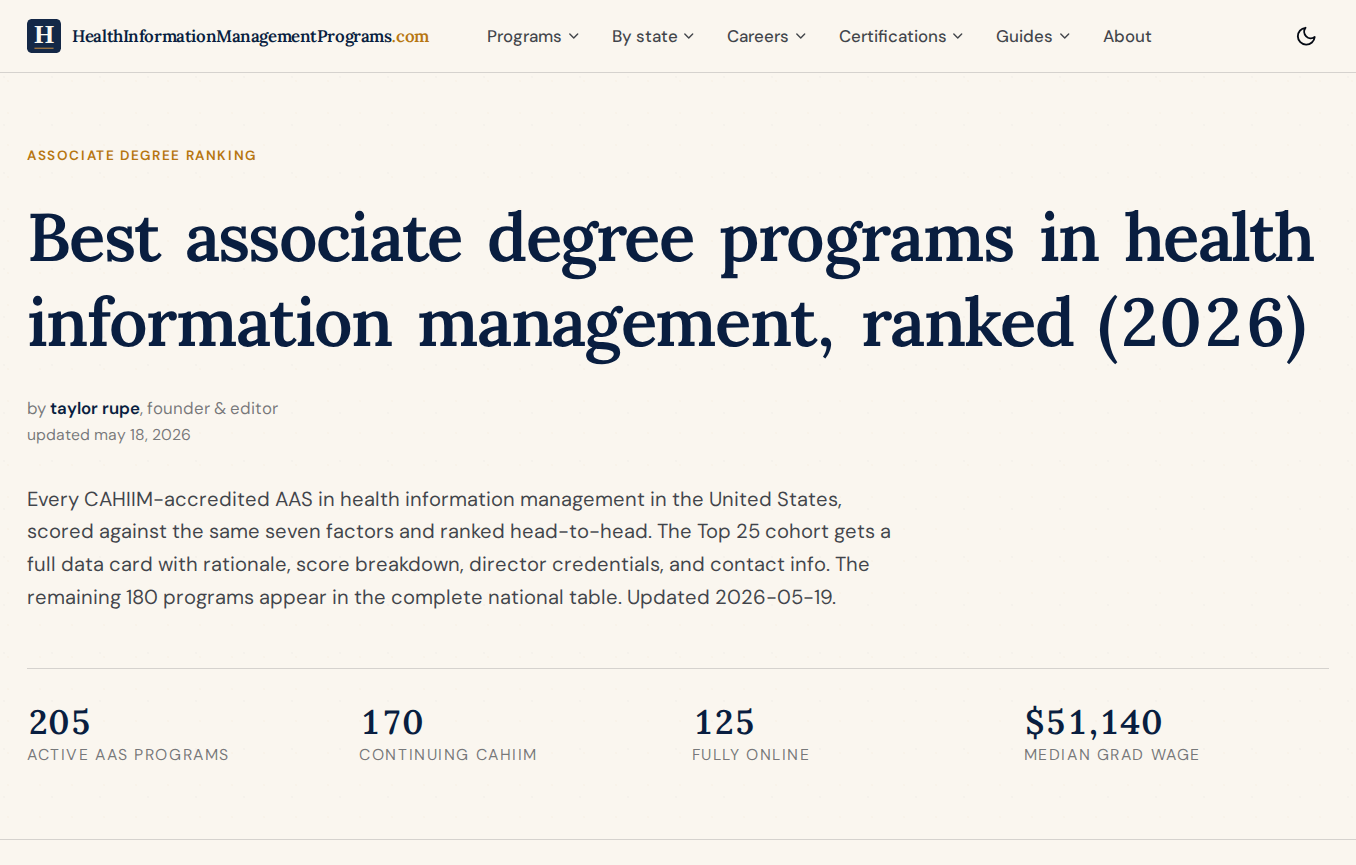
The associates in health information management ranking, with 205 programs scored against the same seven-factor methodology. This is the page community colleges most often cite when they describe their AAS as competitive with peer institutions.
Certification Authority Section
AHIMA's RHIA and RHIT credentials are the certification keywords every HIM career page on the internet competes for, but the searcher's actual question is rarely "what is RHIA" in the abstract. It is "should I take RHIA or RHIT," which the RHIA vs RHIT comparison answers head-on. We added deep guides for CCS, CCA, CDIP, CHDA, and CHPS because together they map the entire AHIMA credential family.
The CAHIIM accreditation guide is the page that gets cited from inside academia. It explains, in plain language, what CAHIIM is and why an unaccredited program is a dead end for RHIA eligibility. That is the kind of explainer that university advising offices and high school counselors actually link to.
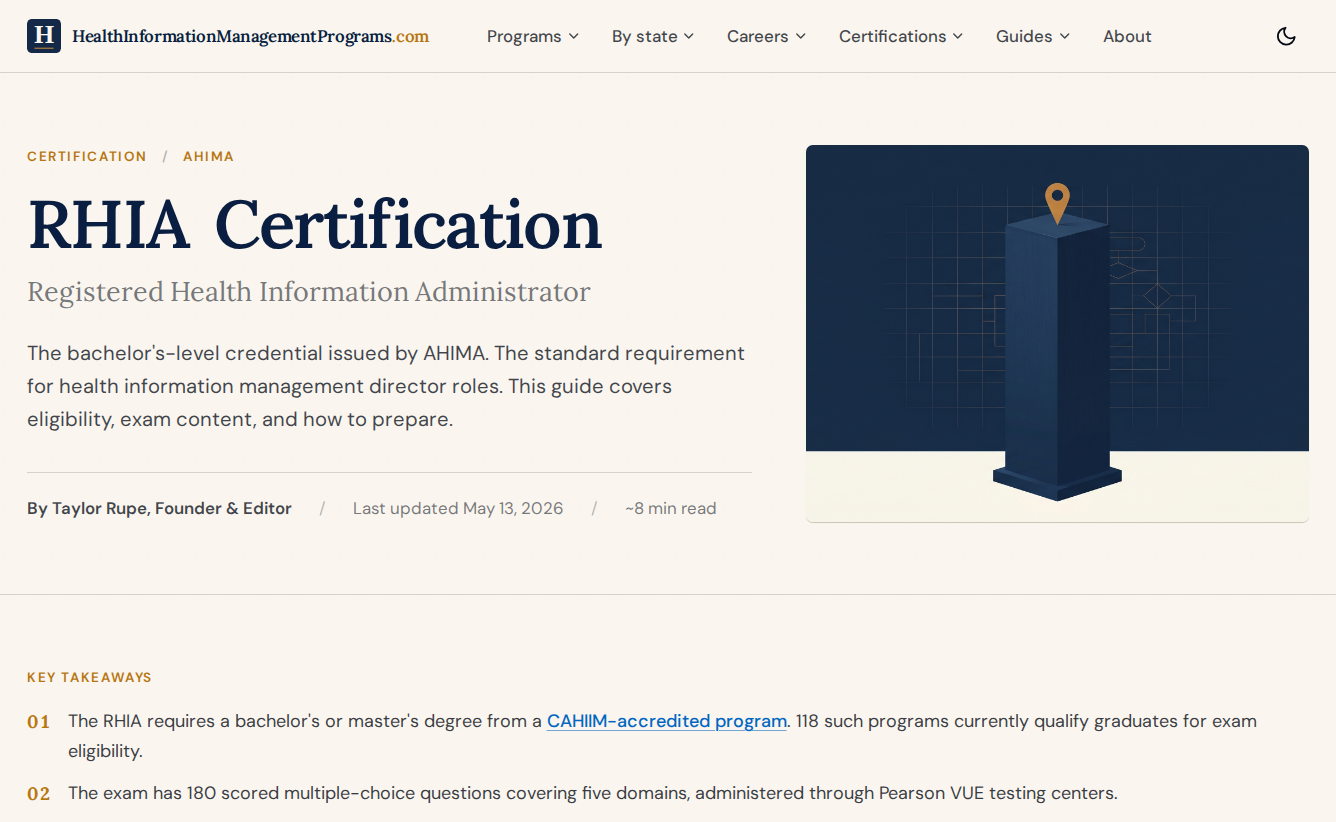
The RHIA certification guide. Author byline, last-updated date, and Key Takeaways above the fold. These are the trust signals editors look for before linking to an unfamiliar domain.
BLS-Backed Wage Data (the journalist magnet)
The salaries section is built from primary Bureau of Labor Statistics OEWS data, with median, 10th, and 90th percentile wages charted per role and per state. It covers medical records specialist salary, HIM director salary, medical coder salary, clinical documentation specialist salary, cancer registrar salary, and health data analyst salary.
Salary content is what journalists and HR blogs cite most often, because it solves a "what's the number" problem in a single screenshot-able chart. We chose to present percentiles rather than just the median, since the realistic range is what makes the data quotable rather than generic.
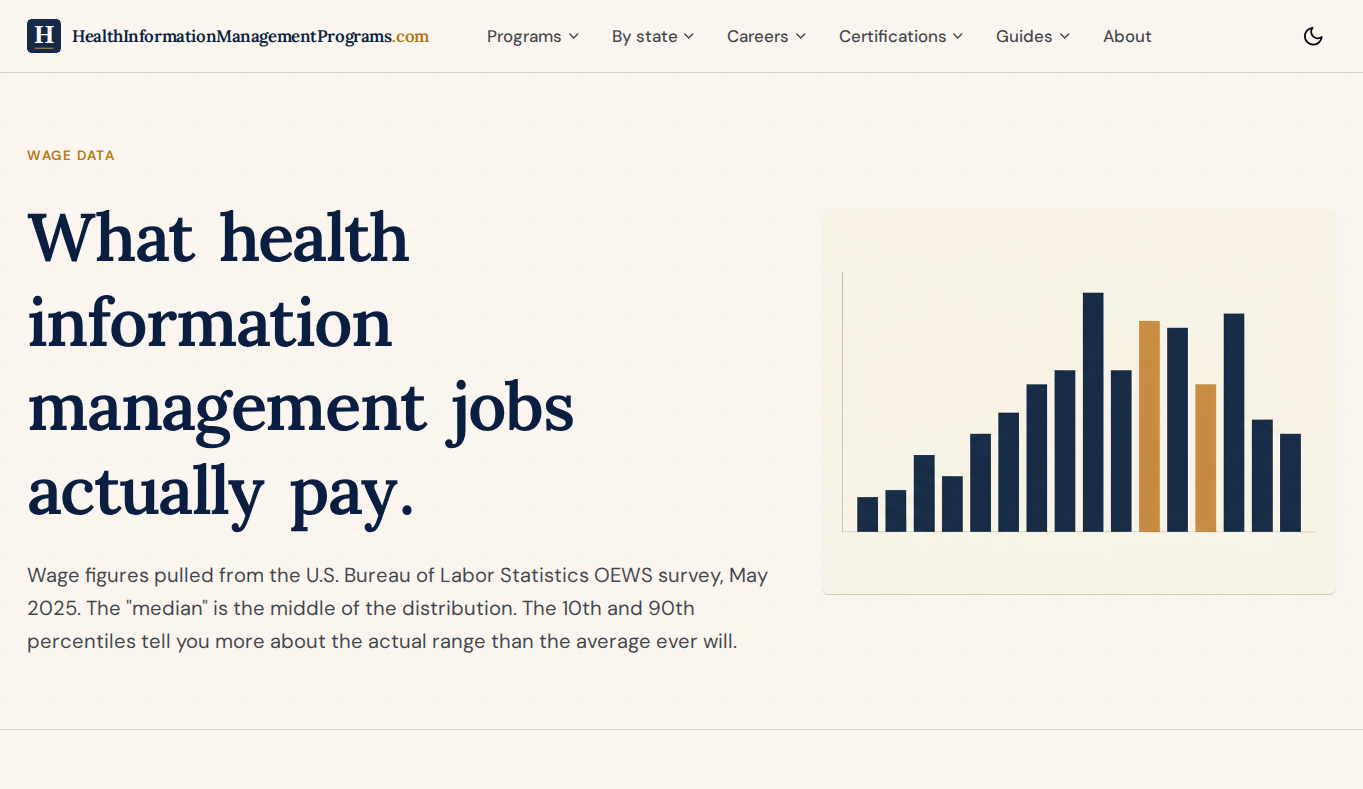
The HIM salary data hub. Every chart is built from primary BLS OEWS data and cited inline, which makes the page safe for editors to reference without fact-checking from scratch.
Editorial Design That Reads Like a Trusted Publication
The design was a deliberate departure from the affiliate-aesthetic that dominates the niche. Cream backgrounds, a dark navy serif for headings, and a single warm orange accent. Every page leads with a real author byline, a visible last-updated date, an estimated read time, and a Key Takeaways callout. Outbound citations to AHIMA, CAHIIM, BLS, and CMS are linked inline and styled like footnotes, not like affiliate buttons.
This matters for link acquisition because editors at .edu and .gov referring sites assess design credibility in about three seconds. A site that looks like a real publication clears that bar; a site that looks like a lead-gen funnel doesn't, no matter how good the underlying content is.
The CAHIIM accreditation guide. Editorial typography, a real author, and inline citations to AHIMA and CAHIIM. This is the explainer page that university advising offices link to.
Performance and Schema for Discoverability
HealthInformationManagementPrograms.com is built on Astro 6 with static generation and deployed to Cloudflare Workers, so every page is pre-rendered HTML served from the edge. There is no client-side framework, no hydration, and no JavaScript bundles to download before the content renders. Core Web Vitals are green across all page types, which matters because slow pages don't earn links, and they don't survive the manual review step that journalists and editors do before quoting a source.
Every page emits Schema.org JSON-LD: Organization, Article, BreadcrumbList, CollectionPage, FAQPage, and Person for the author. The structured data is what surfaces the site in Google's AI Overviews, Perplexity, and other generative search interfaces, which is increasingly where new editorial citations originate.
The Anchor-Text Strategy
Most authority sites are built and then asked, "now what do we link to?" We designed HealthInformationManagementPrograms.com in the opposite direction: we mapped the anchor text we wanted to be able to use first, then built the pages those anchors point to. The result is a site where every editorial mention has an obvious, on-topic destination.
Geographic anchors
"Washington HIM rankings," "California HIM programs ranked," "best HIM schools in Texas." Each of the 48 state pages plus Puerto Rico is a unique anchor opportunity for the schools, employers, and workforce boards in that state.
Degree-level anchors
"Associate degree in HIM," "bachelor's in health information management," "online HIM programs." These are the head-term anchors a career counselor uses when writing a guide. They have to point somewhere, and we wanted them pointing here.
Salary anchors
"Medical records specialist salary," "HIM director salary," "medical coder pay." Salary anchors are the most-used in editorial writing, because journalists and HR bloggers almost always need to attach a number to a job title.
Certification anchors
"RHIA certification," "RHIT certification," "RHIA vs RHIT." Certification anchors carry the most search volume of any category in the HIM space, and they map to evergreen pages that don't need quarterly refreshes.
Authority anchors
"CAHIIM accreditation," "HIM vs health informatics," "nursing to HIM transition." These are the explainers people link to when they need to define a term mid-sentence, and they pull citations from .edu and .gov subdomains.
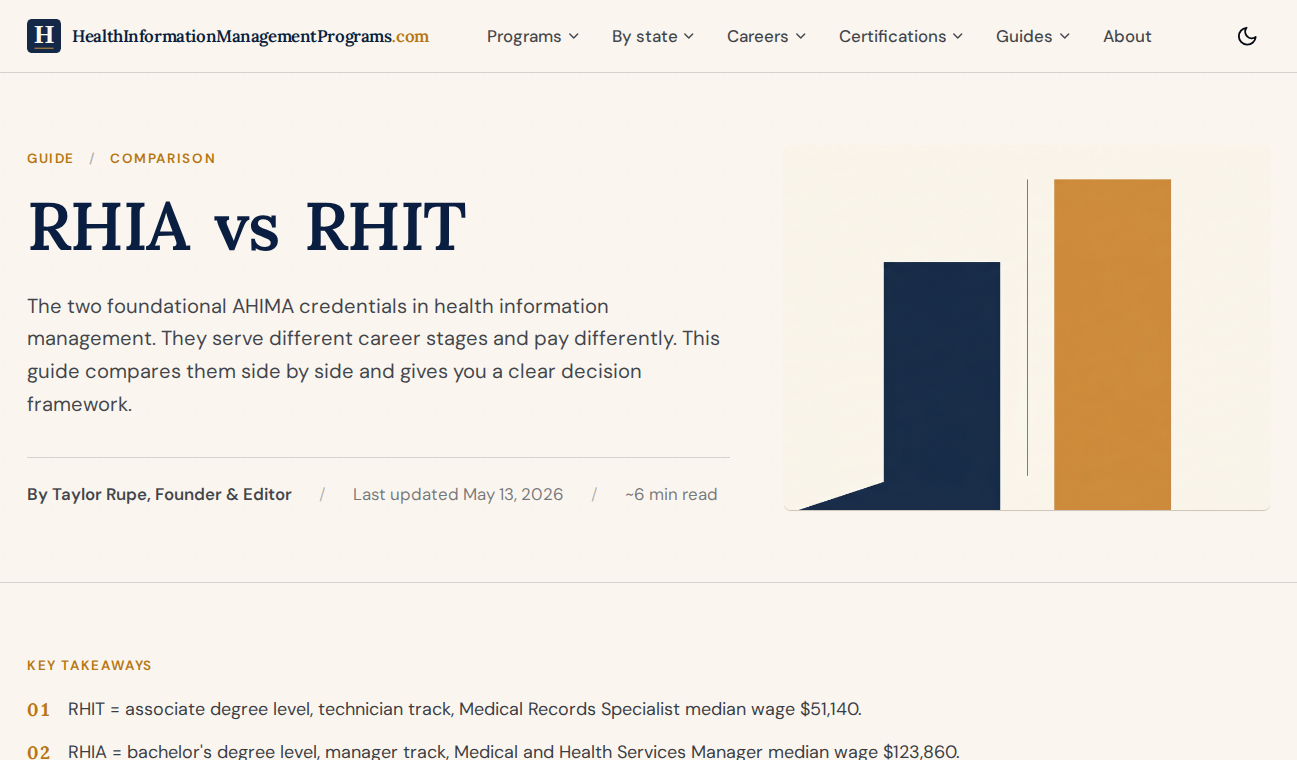
The RHIA vs RHIT comparison page. Comparison pages are the most-linked single-URL anchors in any niche, because they capture an entire keyword cluster with one page.
Technology Stack
The Results
HealthInformationManagementPrograms.com launched with the full spine in place: 48 state rankings plus Puerto Rico, every CAHIIM-accredited program scored against the same seven-factor methodology, the entire AHIMA credential family covered, BLS-backed salary data per role, and a citation-ready editorial design. The site is engineered to compound rather than spike. Every new program added, every quarterly accreditation refresh, every new state-level guide widens the surface area for editorial backlinks.
A 50-state ranking directory covering every CAHIIM-accredited HIM program in the country, each state its own individually linkable anchor target.
Degree-level pillar pages covering the associate, bachelor's, and online HIM tracks, with the associate ranking covering all 205 CAHIIM-accredited AAS programs.
A full AHIMA credential authority section (RHIA, RHIT, CCS, CCA, CDIP, CHDA, CHPS) plus the RHIA-vs-RHIT comparison that captures the entire credential-choice keyword cluster.
BLS-backed salary content for every major HIM role, presented with median and percentile data so the charts are quotable for journalists and HR writers.
Sub-second page loads across every template, green Core Web Vitals, and full Schema.org JSON-LD coverage so the site is surfaced inside AI overviews and generative-search answers.
The bet behind a project like this is that an authority asset built deliberately, with the anchor text mapped first, the directory built second, and the editorial design treated as a credibility signal rather than an afterthought, compounds in a way that outpaces any single page on its own. The state directory is the moat. The certification track is the answer to every keyword cluster that matters. The salary data is the journalist magnet. And the editorial design is what makes editors comfortable linking from .edu and .gov referring domains. Each layer reinforces the others.
Need a Site That Earns Links Instead of Buying Them?
We build authority assets where the anchor text is mapped first, the content is engineered to be cited, and the editorial design makes editors comfortable linking.
Start Your Project